Segway Navimow i220 LiDAR Robot Lawn Mower Test
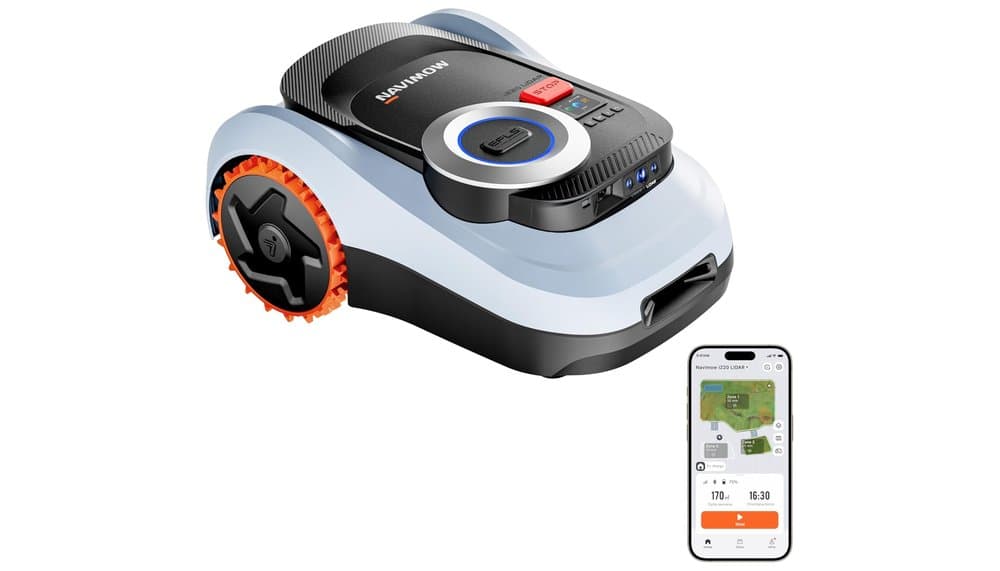
Analysis of the Segway Navimow i220 LiDAR: Is the Future of Robotic Mowing Here?
The wireless robotic lawn mower market is evolving at a breakneck pace. Each season brings its share of new products, promising ever more autonomy and fewer constraints. With its i220 LiDAR model, Segway makes a major move by offering a solution that eliminates the need for perimeter wire and an external RTK antenna. Is this promise of an ultra-simplified "plug & play" installation delivered? This technical analysis examines the specifications, user feedback, and expert opinions to determine if this robot deserves a place in your lawn maintenance strategy.
Strengths and Weaknesses
What We Like
- Revolutionary Installation: No more wire to bury, no antenna to position. This is the key selling point. You take the machine out of its box, place it on its base, and setup is done via the app.
- Precision Navigation: The hybrid Solid-state LiDAR + Vision navigation system enables precise laser mapping and methodical path following (parallel lines), far from the random movement of many competitors.
- Terrain Versatility: All-terrain wheels and power advertised for slopes up to 45% (approx. 24°) make it a serious contender for hilly gardens.
- Sophisticated Application: Multi-zone management (up to 20), a drawing tool for custom mowing patterns, and voice control (Alexa/Google) offer a rare level of control.
What Gives Us Pause
- Autonomy and Practical Coverage: A 10 Ah battery and advertised mowing area of 2000 m² hide an operational reality. Feedback indicates that one charge covers about 560 m². For a lawn of the maximum size, several recharge cycles will be necessary.
- Technological Dependence: Such advanced navigation relies on complex sensors and software. The long-term reliability and weather resistance (fog, heavy rain) of the optical and LiDAR sensors remain to be confirmed over time.
- Entry Price: This cutting-edge technology sits at the high-end of the market, representing a significant initial investment.
- Navigating Narrow Passages: With dimensions of 63.5 x 44.5 cm, the robot requires sufficiently wide paths to maneuver. Its size can be a hindrance in gardens with very winding or compartmentalized layouts.
Detailed Technical Analysis
Cutting System and Performance
The Navimow i220 LiDAR uses a rotating disc system equipped with 6 blades. This principle is common among robotic mowers and allows for a fine mulching cut: the grass is finely chopped and returned to the soil as natural fertilizer. The cutting width is 22 cm, which is on the higher side of average, allowing it to cover a reasonable area per pass.
The cutting height is automatically adjustable via the app within a range of 2 to 7 cm. This is a practical feature that allows adjusting the height according to the season or lawn condition. The 100W motor is presented as powerful enough for dense grass.
Navigation and Artificial Intelligence
This is the core innovation. The robot combines a solid-state LiDAR and vision cameras to locate itself and navigate. Unlike RTK systems that depend on a satellite signal and external antenna, this solution is completely autonomous. The LiDAR scans the environment to create a precise 3D map, while the cameras assist with obstacle recognition.
The GeoSketch function in the app allows defining mowing zones, no-go zones, and even creating "paths" to connect different parts of the garden (like front and back yard) with a precision of 0.4 inch (approx. 1 cm). The "Overlap" mode ensures edges are perfectly mowed.
Slope Capability: The advertised 45% is impressive on paper. The all-terrain wheels and weight distribution are designed to maintain traction. However, as with all robots, actual performance will also depend on soil moisture and slope regularity.
App Management and Connectivity
The Segway Navimow app is the control center. Besides initial mapping, it allows:
- Zone Division: Define up to 20 zones with different schedules and cutting heights.
- Creative Tools: The "Doodle" allows drawing custom mowing patterns.
- Security: Lift alert, geo-fencing to prevent exiting the defined zone, automatic return to base in case of bad weather (detected rain).
- Scheduling: Fine-grained scheduling of mowing times.
Connection is via Wi-Fi and Bluetooth, and an optional cellular connection (via the Connect+ subscription) allows for remote tracking even outside the local network.
Autonomy and Recharging
The technical sheet indicates a 10Ah battery. According to manufacturer data, this allows up to 210 minutes of autonomy, covering about 560 m² per charge cycle. For a 2000 m² lawn, the robot will therefore need to make several trips back to its base during the day. This point is crucial to consider based on the actual size of your property. Recharging is done automatically on the supplied base.
Installation and Maintenance
Installation is presented as extremely simple: place the base, create the map via the app by manually guiding the robot around the boundaries. This is a huge time saver compared to burying a wire. Daily maintenance is limited to regular cleaning of the chassis and wheels, and blade replacement (a set is usually included) after a few seasons, depending on usage.
Key Technical Specifications
| Category | Specification Segway Navimow i220 LiDAR |
|---|---|
| Type | Wireless robotic lawn mower (virtual perimeter) |
| Navigation | Solid-state LiDAR + Vision (no wire or external RTK antenna required) |
| Max. Advertised Area | 2000 m² |
| Practical Area / Charge | ~560 m² (estimate based on autonomy) |
| Autonomy | Up to 210 min |
| Battery | 10 Ah |
| Cutting Width | 22 cm |
| Cutting Height | Automatically adjustable from 2 to 7 cm |
| Cutting System | Rotating disc with 6 blades (mulching) |
| Max. Slope | 45% (approx. 24°) |
| Motorization | 100W cutting motor, 2-wheel drive |
| Connectivity | Wi-Fi, Bluetooth, optional cellular (Connect+) |
| Application | Multiple zones (20), scheduling, GeoSketch, voice control |
| Dimensions (LxWxH) | 63.5 x 44.5 x 28.8 cm |
| Weight | 15.1 kg |
| Safety Features | Lift detection, geo-fencing, auto return to base |
What Users Say: Summary of Feedback
Available customer reviews (mainly British) paint a very positive picture, with an average rating of 4.8/5 stars. Several trends emerge.
Recurring positive points are:
- Simple and Quick Installation: The majority agree on the ease of setup. "Easy to setup" is a recurring phrase. Users appreciate not having to manage a cable.
- Impeccable Mowing Result: Feedback mentions a "consistently neat" lawn, "like maintained by a professional," with no uncut strips.
- Intelligent Navigation: The ability to create precise maps and follow methodical routes (lines) is praised. Managing separate zones (front/back garden) via a "virtual path" works well.
- Quiet Operation: Its low noise level allows for use at any hour without disturbance.
Points of caution or criticism raised are:
- Real Autonomy: One user explicitly notes that the area covered per charge is below initial expectations, confirming the gap between theoretical maximum and practical area.
- Base Station Placement: Although the RTK antenna is integrated, one review indicates they had to reposition their base station to get a good signal, a reminder that the technology remains sensitive to the immediate environment (thick walls, basement).
- Base Station Light: One user finds the base station LED too visible at night, potentially attractive to thieves.
- Comparison with Competition: A user coming from another wireless brand notes that the Segway has better performance on uneven terrain but regrets the absence of an "FPV" mode (live camera view) present on the competitor, which they found fun and useful for checking the garden.
Conclusion: Who Is It Right For?
The Segway Navimow i220 LiDAR is not just an evolution, it's a revolution in the approach to robotic mowing. By removing the wire and external antenna, it solves the two main installation constraints that deterred many gardeners.
This robot is for you if:
- You have a medium to large garden (up to 1500-2000 m²) with a layout that allows for recharge cycles.
- Your terrain has significant slopes (up to 45%).
- You hate the idea of spending hours burying a cable and want a "ready-to-use" solution within hours.
- You seek a meticulous and structured mowing result (parallel lines) and want granular control via a modern app.
You might consider other options if:
- Your lawn is small and very compartmentalized with narrow passages (< 70cm).
- Your absolute priority is the lowest price for basic mowing.
- You need to mow more than 600 m² in one go without interruption for recharging.
- You are in an area where very dense fog or heavy rains are frequent and could disrupt the optical sensors.
Our final verdict: The Segway Navimow i220 LiDAR is a technological feat that largely delivers on its promises of installation simplicity and mowing precision. It represents the future of the category. Its main compromise lies in practical autonomy, which requires planning for large areas. For the modern gardener who values their time, seeks an impeccable result, and is ready to invest in a high-end, truly wireless solution, it is very likely an excellent choice, perhaps even the best currently on the market in its category.
100% free and independent — All our articles are written independently, without any sponsorship. We may earn a commission on purchases made through our links, at no extra cost to you.
Articles you might like
Fader Electric USB Rechargeable Hair Clipper Review
Review of the Fader USB rechargeable hair trimmer from a gardening tool perspective. A technical analysis of its specs, design, and user feedback.
WORX WG737E Cordless Lawnmower Review and Test
Experience the WORX WG737E Nitro cordless mower. Brushless motor & Intellicut tech deliver effortless, quiet power for lawns up to 500m².
LUBA mini AWD 800 Robot Lawn Mower Test & Review
LUBA mini AWD 800 robot mower for sloped gardens up to 800 m². Uses GPS & sensors for cable-free navigation and precise, autonomous mowing.
Guides you might like

Ultimate Guide to Gas Mowers
Petrol lawnmowers provide power & autonomy for large lawns over 500 m². Key features & selection criteria for your garden explained.
Buying Guide: Choosing Your Thermal Brushcutter
Guide to choosing a thermal brushcutter: Compare 2-stroke vs. 4-stroke engines and harness types for effective clearing of brambles and sloped terrain.

Wireless robotic lawn mower guide
Choose the perfect cordless robotic lawn mower. Learn to match battery life, cutting width, and your garden's layout for a flawless, hands-free lawn.