scarifier buying guide
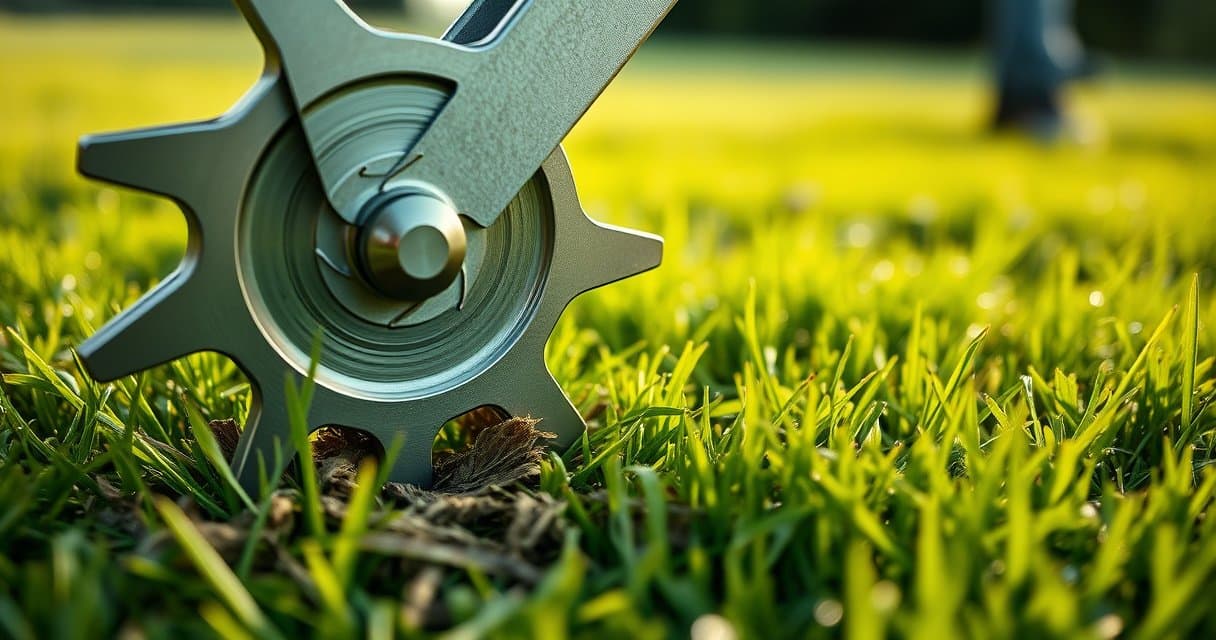
Is your lawn looking dull and spongy despite all your care? This is likely a sign that it's suffocating under a layer of thatch. Choosing the right scarifier will help you bring it back to life by removing this invisible barrier, but you need to avoid the pitfalls of buying one unsuited to your land. Let's break it down.
Key Points to Remember
- Scarification is necessary if the screwdriver test reveals a thatch layer thicker than 5 mm suffocating your lawn.
- The choice of scarifier depends primarily on the area and layout of your land to avoid an unsuitable model.
- For optimal results, scarify in spring or early autumn, performing a crosswise pass after a close mow.
- An integrated collection box is essential to save time and avoid manual raking of debris.
- Regular maintenance, particularly sharpening the blades, is crucial for the longevity of the machine and the effectiveness of the work.
How to know if your lawn really needs to be scarified?
This is the question everyone asks before investing. We sometimes tend to scarify out of habit in spring, but it's not always necessary, and an unjustified operation can weaken your lawn. So, how to decide?
The telltale signs
First, observe your lawn's behavior. Does it feel spongy underfoot? That's a first clue. Do the rake test: vigorously scratch a small area with a lawn rake. If you bring up an impressive amount of yellowish, fibrous debris – that's thatch – and the living grass seems sparse underneath, it's a clear signal.
Another classic situation: water runs off the surface instead of soaking in, even after a light rain. The soil is like impermeable. This means the thatch, this layer of dead organic matter, acts like roofing felt and blocks everything. Finally, look at the density. A lawn that thins out easily, with patches of bare earth, often has a thatch problem that suffocates new growth.
The objective assessment: the "screwdriver test"
Here is a simple and foolproof method. Take a flat-head screwdriver and try to push it vertically into the soil, through the grass. If you encounter strong resistance before even reaching the soil, like a thick, dense layer, you have your verdict.
To be precise, measure this layer. If it exceeds 5 millimeters thick, scarification is recommended. Below that, your lawn probably still breathes well enough. Light aeration (with spiked shoes or a roller aerator) might suffice. Frankly, no need to traumatize your lawn with blades if it doesn't need it.
When to (sometimes) refrain
There are situations where scarifying would be a mistake. On a very young lawn (less than two years old), the roots are too shallow and the operation risks pulling everything up. If your soil is extremely sandy and naturally poor in organic matter, thatch hardly forms. And of course, during drought or a heatwave, you would stress the lawn at the worst possible time. Wait for a period of active growth and mild weather.
What Type of Aerator to Choose Based on the Surface Area and Layout of Your Garden?
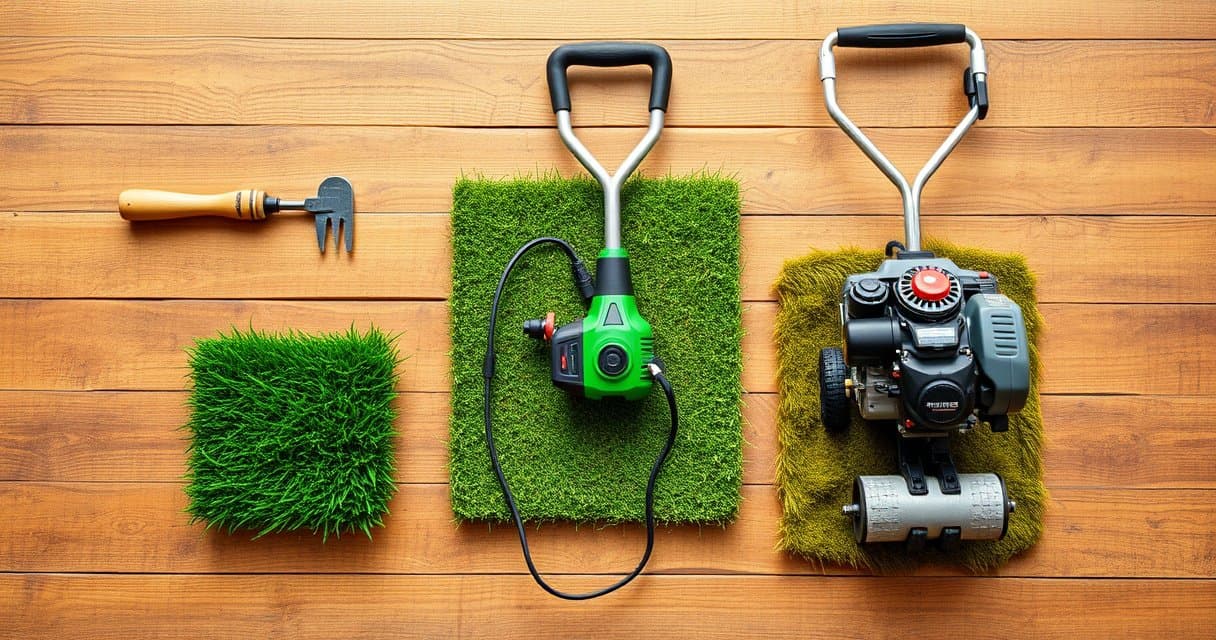
This is the most important choice. Getting it wrong here means subjecting yourself to hours of unnecessary hassle or spending far too much on an oversized machine. Let's keep it simple: everything starts with your lawn.
The Area to Treat: Your First Filter
Forget manual models for anything over 200 m², unless you're into extreme fitness. They are perfect for a small square of garden or local touch-ups, but frankly exhausting on a real lawn.
For most urban and suburban gardens, let's say between 200 and 600 m², the debate is between corded electric and battery-powered models. Corded electric often offers the best power-to-price ratio at this level. But be careful: do you have an outlet within 30 meters of every corner of the lawn? If not, you'll spend your time managing extension cords, and it's a real ordeal. Battery-powered aerators (choose at least 36V) free you from this problem, at the cost of a slightly higher investment and battery life management.
Beyond 800-1000 m², especially if the terrain is sloped or very long, a petrol model becomes essential. Its constant power and total autonomy are unbeatable. The downside is the weight, noise, and annual engine maintenance. Reserved for large properties.
The Layout of the Terrain: The Details That Make the Difference
Surface area doesn't tell the whole story. Is your garden a large open rectangle or a puzzle of flower beds, trees, and narrow passages? Maneuverability then becomes crucial.
For gardens with many obstacles, a modest working width (32-35 cm) is an asset, not a weakness. It allows for easier navigation. An aerator that is too wide becomes a nightmare between two rose bushes. Also check the turning radius and the weight of the machine. Electric models are generally lighter and more maneuverable than their petrol counterparts, which matters a lot on a complex terrain.
Another underestimated point: the slope. If your lawn has a pronounced slope, traction power is key. A petrol engine or a high-power electric motor (1800W and above) will have a much easier time climbing without you having to push like crazy. Basic entry-level models often struggle as soon as the incline exceeds 10%.
The Combined Terrain Verdict
Let's take concrete examples. For a 150m² urban backyard, without a slope but with limited access to outlets: a quality manual aerator or a small 36V battery-powered model will do the job.
For a 400m² family garden with a large tree in the middle and a gentle slope: a 1500-1700W corded electric model with a 36 cm width is ideal. Plan for a good extension cord.
For a 1500m² countryside property, open and with a regular slope: here, you need to switch to petrol. You would bitterly regret anything else; autonomy and raw power are non-negotiable here.
Our Selection
For a healthy lawn, scarification and aeration are key steps. No need to tackle them by hand; an electric scarifier is the ideal ally. We have analyzed three popular models, with similar characteristics but important nuances. By cross-referencing technical specifications and community feedback, here is our clear view to help you make the right choice.
| Product | Power | Working Width | Collection Box Capacity | Key Strengths |
|---|---|---|---|---|
| Einhell GE-SA 1435-1 | 1400 W | 35 cm | 28 L | 3-in-1 tool, tool-free changeover, adjustable handlebar |
| Einhell GC-SA 1231-1 | 1200 W | 31 cm | 28 L | Asynchronous motor, excellent finish, compact |
| Scheppach SC32 | 1500 W | 32 cm | 30 L | Most powerful motor, fine adjustment on 4 levels |
Einhell GE-SA 1435-1
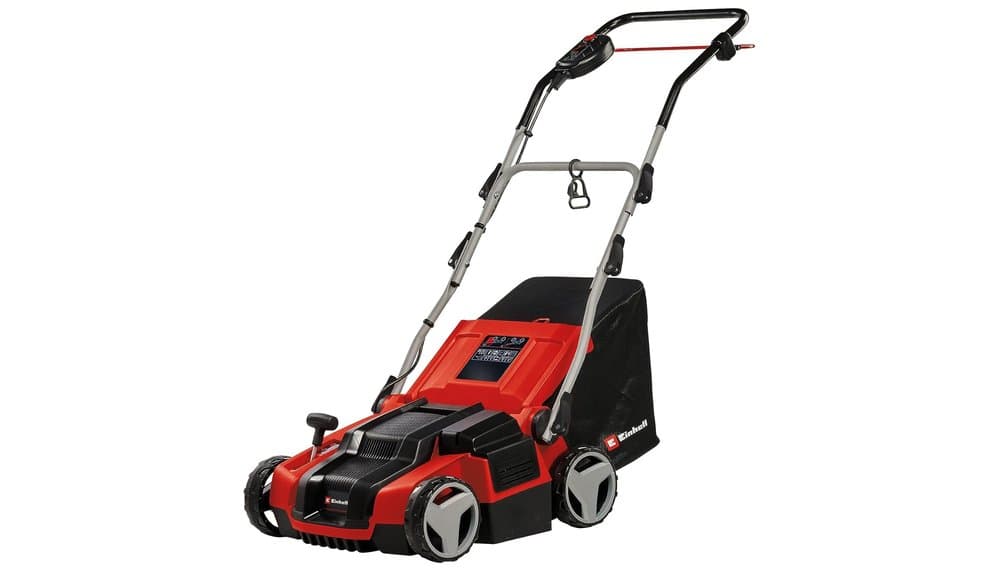
This model presents itself as a very comprehensive all-in-one. On paper, its specifications make it a versatile tool for regular maintenance. The central point, according to the manufacturer, is its integrated 3-in-1 system including a scarifying roller (16 blades), an aerating roller (24 tines) and a large 28-liter collection box. The tool-free roller change argument is regularly praised in reviews for its simplicity and time-saving.
On the community side, feedback is mostly positive regarding its overall robustness and effectiveness for dethatching medium-sized lawns. The 1400 W power is considered sufficient for most tasks, even on slightly compacted soil. Users also appreciate the height-adjustable and foldable handlebar, a real plus for ergonomics and storage.
However, the analysis of reviews also reveals some limitations. Some users note that the appliance, although sturdy, can feel a bit "plasticky" on certain parts, raising questions about its longevity in case of intensive use over several years. Another point raised: its weight (over 10 kg). While it ensures a certain stability, it can make it slightly less maneuverable for some, especially on turns or sloped terrain. Finally, although the 28L box is practical, it needs to be emptied relatively often on a very mossy surface.
Einhell GC-SA 1231-1
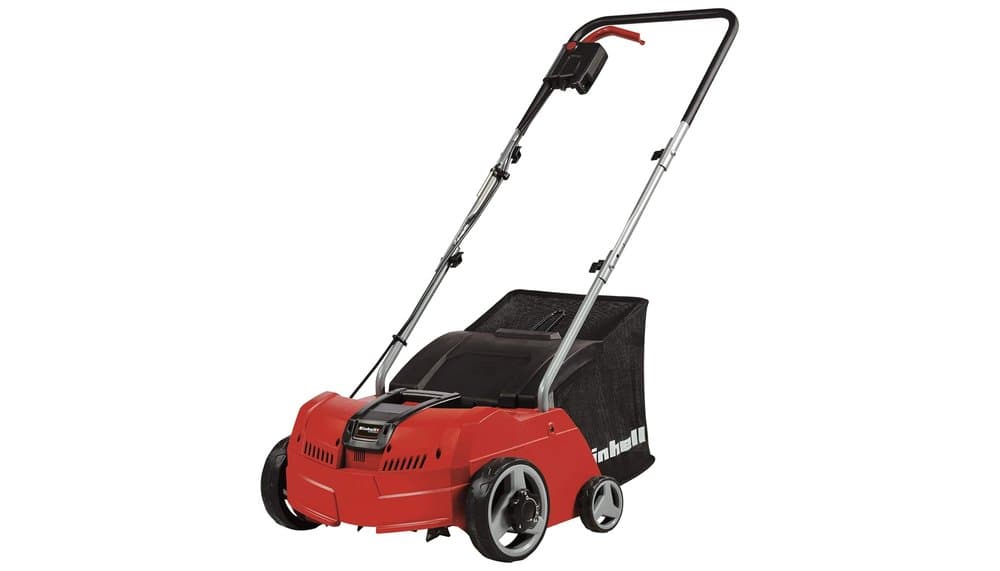
Here we are dealing with a model often seen as the ideal compromise for small to medium-sized gardens (up to 300 m² according to the manufacturer). Its 1200 W asynchronous motor is a technological strong point often highlighted. This type of motor, according to feedback, is known for providing high torque and a steady working progression, even in dense grass, often with less vibration.
Customer reviews unanimously emphasize its perceived excellent value for money. Its weight of about 9.7 kg and its 31 cm working width make it a very maneuverable and easy-to-store appliance. The finish is often described as neat for its category. The 3-level depth adjustment system is considered simple and effective for adapting to the lawn's condition.
The limitations noted by users are logical given its positioning. Its narrower working width (31 cm) means it will take a bit longer to cover large surfaces than the GE-SA 1435-1. That's the price for its maneuverability. Furthermore, it is a 2-in-1 (scarification/aeration with collection), whereas the previous model includes both rollers separately. Here, the aerating roller has 42 tines, a high number that, according to the specs, promises effective aeration, but some would have preferred a roller change as simple as on the 3-in-1 model.
Scheppach SC32
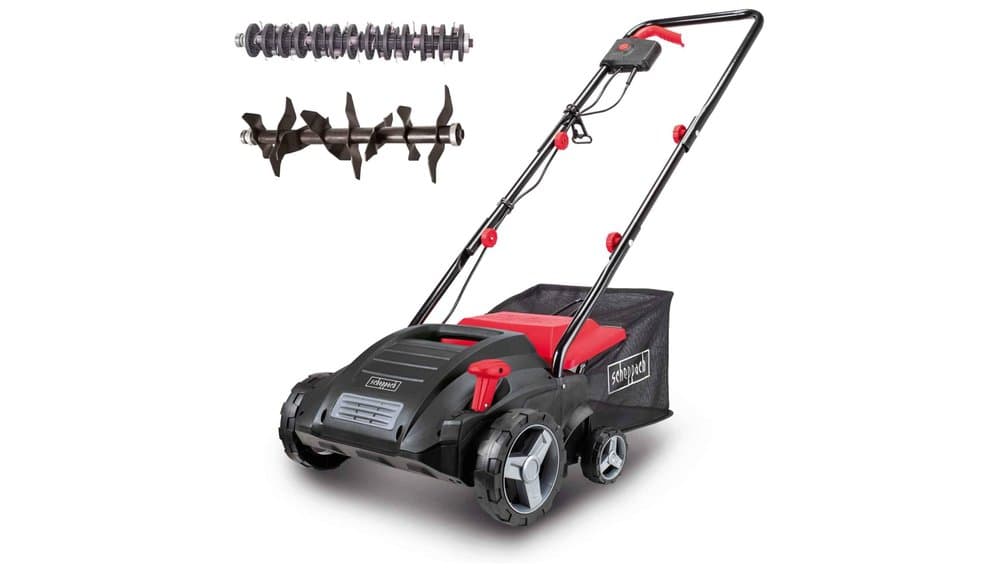
The Scheppach SC32 bets on raw power with its 1500 W motor, the highest in this selection. On paper, this makes it the tool most capable of tackling a lawn heavily invaded by moss and thatch without stalling. Its height adjustment on 4 positions, precise down to 4 mm depth, is an asset for fine, adapted work.
The user community validates this impression of a sturdy and high-performing machine. Feedback often mentions a formidable effectiveness in regenerating lawns in poor condition. The 30-liter collection box, slightly larger than those of the Einhell models, is appreciated for reducing the frequency of emptying breaks. The appliance is also described as relatively stable and well-balanced during use.
However, this power has a downside. Several reviews mention that the appliance can be a bit louder than its competitors, which is a factor to consider depending on your environment. Another point of caution raised by some: the after-sales service and availability of spare parts for the Scheppach brand sometimes seem less obvious or less documented by users than for Einhell, a very established brand. Finally, its weight (9.3 kg) is contained, but its maneuverability is sometimes judged slightly inferior to that of the GC-SA 1231-1 due to its center of gravity.
Comparing Technical Options: Width, Depth, Collection Box and More
Now that you know what type of motorization you're aiming for, let's look at what's under the hood. It's in these details that the real difference is made between a tool that simplifies your life and a machine of frustrations. Don't be blinded by the advertised power alone; it's not everything.
The Essentials: Working Width and Collection Box
The working width is one of the first pieces of data to check. You generally find models between 30 and 45 cm. A 32 cm model will be perfectly manageable in a garden with tight turns and obstacles, but you'll make more passes. A 40 cm scarifier will cover the area faster, but will be wider, heavier, and less agile. For an average garden with a regular shape, a width of 35-38 cm often represents the right compromise.
Next, let's talk about the box. Frankly, a scarifier without an integrated collection box is almost nonsense in my opinion. You'll spend hours raking behind yourself, and it's the best way to put the appliance at the back of the garage for good. Check its capacity (between 40 and 55 liters for most) and especially, how easy it is to empty. A quick-emptying system, sometimes by simple tipping, is a luxury you won't go back from. Some boxes are transparent, allowing you to see the fill level without stopping - a detail that changes everything.
The Adjustments: Precision in Service of the Result
This is where appliances differentiate themselves. The depth adjustment is crucial. Avoid basic systems with only 2 or 3 positions. Prefer a dial or lever that allows for progressive adjustment, by millimeters. Why? Because you won't scarify a fine and delicate lawn in the same way as an old, thick lawn invaded by thatch. For a first operation, start gently, at -2 or -3 mm, before considering a deeper pass.
Some models offer an interchangeable scarification chassis. It's a real plus. You can replace the blade roller with an aerator roller (equipped with spikes). This allows you to aerate the soil deeply without dethatching, a complementary but different operation, ideal for very compacted grounds. It's a heavier initial investment, but one that avoids buying two machines.
Construction and Practical Details
Pay particular attention to the quality of the blades. Blades made of good thickness hardened steel will last several seasons, while others made of softer steel will bend or wear out quickly on slightly stony soil. Their number also influences the fineness of the work: the more blades there are, the more homogeneous the result.
Finally, think about daily ergonomics. An adjustable height handle, wide wheels to avoid sinking into soft soil after rain, and a compact storage system (folding handle, removable chassis) are considerable advantages that don't appear on technical datasheets, but make all the difference on the day you have to take it out of the shed or store it for the winter.
Optimizing the Operation: When and How to Scarify for Lasting Results

Having the right scarifier is one thing. Using it at the right time and in the right way is what guarantees a transformed lawn rather than a battlefield. Following a precise methodology makes all the difference between success and disappointment.
The Perfect Timing: Your Annual Calendar
Scarifying is a controlled aggression for your lawn. It should therefore be done when it has all the energy to rebuild itself, meaning during its active growth periods.
The ideal window is in spring, between mid-April and mid-May. Wait until the soil is well warmed up and the grass has started its vigorous growth. The other perfect time is early autumn, in September. The soil is still warm, the nights are humid, and the lawn has plenty of time to regenerate before winter. Avoid summer at all costs: the water stress is too great. Also avoid winter, as growth is nil.
A foolproof test? Push a screwdriver into the soil. If the soil is too hard like in a dry summer, or too waterlogged like after heavy rains, postpone the operation. You are aiming for a slightly moist consistency, no more, no less.
The Preparation: Do Not Neglect This Step
The day before or two days before the operation, mow your lawn. But not just anyhow. Set your mower to the lowest height (without scalping it right down to the soil, of course). The goal is to clear the grass blades as much as possible so that the scarifier's blades reach directly the layer of thatch at the base.
Remove all visible debris: branches, leaves, toys. It seems obvious, but a small stone or a piece of wood can seriously damage the blades.
The Passing Technique: Cross-Passing to Eliminate Everything
Start your machine and begin with a shallow setting, especially if it's a first scarification or if you are unsure of the thatch thickness. It's better to go gently.
Pass the machine in straight, parallel lines, like for mowing. But the secret is cross-passing. Once this first grid is finished, pass your scarifier again perpendicularly, at 90 degrees. This technique cuts the thatch into small squares and extracts it evenly, without leaving any intact areas. You'll see the amount of waste in the collection box; it's quite impressive!
If, after this double pass, you notice that certain areas have very thick thatch, you can adjust the depth one notch lower and pass only over those spots again. No need to redo everything.
Post-Operative Care: Helping It Recover
Once finished, your lawn will look like a desert. This is normal, and is even a sign that the job was done well. Do not leave it in this state.
First step: eliminate the last residues. Give it a pass with a lawn rake or a light blower to remove the small debris that were not captured by the collection box.
Second step, and this is crucial: watering. Water copiously to help the soil settle slightly and come into contact with the roots. In the following days, monitor the soil moisture.
Finally, within the week after, provide a nutritional boost. A "overseeding" or "restart" type fertilizer, rich in phosphorus to stimulate root development, is ideal. You can also take advantage of this exposed soil to sow a few grams of grass seed in the most sparse areas.
Anticipating Equipment Maintenance and Long-Term Usage Costs
We often think about the purchase price, but honestly, the long-term cost is what truly makes the difference between a good and a bad deal. A poorly maintained scarifier can fail after three years, while a well-cared-for model will last you ten years without a hitch. Let's see what awaits you after the purchase.
Post-Use Maintenance: 15 Minutes that Preserve Your Investment
When you're finished, your machine is full of soil, sap, and damp plant debris. It's the perfect cocktail for corrosion and clogging. Never wait until the next day.
Start by completely unplugging the device (or removing the battery). Turn it on its side, preferably on an old tarp. Scrape off residue stuck between the blades and the housing with a soft wire brush or a flathead screwdriver. A low-pressure water jet can help, but you must then dry meticulously all metal parts to prevent rust. A tip? Wipe a lightly oiled cloth (classic 3-in-1 oil) over the blades and visible axles. This forms a protective barrier.
Empty and wash the collection box with soapy water, let it dry completely before storing it. Check the blade fixing nuts – with vibration, they tend to loosen. A quick tightening with the provided wrench is the right reflex.
Seasonal Overhaul: Sharpening and Checks
Before each scarification season, meaning once or twice a year, devote half an hour to your device.
The most critical point is blade sharpening. Dull blades no longer cut the thatch, they tear it, which unnecessarily stresses the grass. If you're a bit handy, you can remove them (note the assembly order carefully!) and run them over a bench grinder. Otherwise, entrust them to a professional. It's inexpensive and makes all the difference.
For thermal models, this overhaul includes the usual: changing the engine oil (after the first year), replacing the spark plug, cleaning the air filter. For electric models, inspect the power cord for cuts or wear. For battery-powered models, follow the manufacturer's recommended charging cycles. Never leave the battery completely discharged in a corner of the garage for six months; it's the best way to kill it.
Hidden Costs to Budget For
The initial price is only part of the story. Here's what to plan for in addition:
- Inevitable Wear Parts: Blade sets need to be changed every 3 to 5 years depending on usage and soil type (sandy soil wears less than stony soil). Expect between €25 and €60 for a quality kit.
- For Thermal Models: Engine oil and ethanol-free fuel (preferable for engine lifespan). This is an annual budget of about €15-20.
- For Corded Models: A good, sturdy extension cord of suitable gauge (1.5 mm² minimum) if you don't have one. This is a one-time investment of €30 to €50.
- For Battery-Powered Models: The battery will eventually lose capacity. A replacement battery often costs between €80 and €150. This is an argument for choosing a brand whose battery ecosystem is shared with other garden tools.
My opinion? Many underestimate blade sharpening. They later complain that the machine "pulls" or vibrates. A well-sharpened blade works quietly, with surgical sharpness. It's the first maintenance item, and the most cost-effective.
Conclusion
The right dethatcher transforms a difficult chore into regular and effective care for your lawn.
Take the time to assess your actual needs. A small area? A manual model will do the job perfectly. A large plot? The autonomy of a gas-powered or powerful cordless model will be justified.
The choice is not just about power. Consider the working width, the collection bag, and above all, the maintenance you are willing to provide. A well-maintained appliance lasts a decade.
So, observe your lawn. Measure your land. And make the choice that will simplify your life next spring, and for years to come. Your lawn will thank you with its vigor and vibrant green.
Frequently Asked Questions
How do I know if my lawn needs dethatching?
Perform the screwdriver test: if you encounter a dense layer of thatch over 5mm thick when trying to push it into the soil, dethatching is necessary to allow water and nutrients to penetrate.
Which dethatcher should I choose for a 400m² garden with obstacles?
Opt for a corded electric dethatcher with a power of 1500-1700W and a modest working width (about 35 cm) for good maneuverability between flower beds and trees, ensuring you have a power outlet nearby.
What is the best time to dethatch a lawn?
The ideal windows are spring (mid-April to mid-May) and early autumn (September), when the soil is warm and the lawn is in an active growth period to recover well from the operation.
Is a collection box necessary on a dethatcher?
Yes, an integrated collection box is highly recommended, as it avoids having to manually rake the huge amount of thatch and debris removed, saving considerable time.
How to properly dethatch a lawn?
Run the machine in parallel lines, then make a second pass perpendicular at 90° to cut and extract the thatch evenly, starting with a less aggressive depth setting.
How to maintain your dethatcher after use?
Thoroughly clean the blades and housing of plant debris and dry them to prevent rust, then check and tighten the blade mounting nuts which tend to loosen with vibrations.
100% free and independent — All our articles are written independently, without any sponsorship. We may earn a commission on purchases made through our links, at no extra cost to you.
Guides you might like
Buying Guide: Choosing Your Thermal Brushcutter
Guide to choosing a thermal brushcutter: Compare 2-stroke vs. 4-stroke engines and harness types for effective clearing of brambles and sloped terrain.
Ultimate Guide to Gas Mowers
Petrol lawnmowers provide power & autonomy for large lawns over 500 m². Key features & selection criteria for your garden explained.
Best Cordless Lawn Mower
Enjoy lawn care freedom: silent, instant-starting cordless mowers. Key tips on battery runtime & power selection for your perfect match.
Articles you might like
Ryobi One+ RLM18X33B40 18V Cordless Mower Review
RYOBI 18V cordless mower for small gardens, part of the ONE+ ecosystem using a universal battery compatible with over 200 tools.
Alpina AL4 46 SA Petrol Lawnmower Review & Test
Alpina AL4 46 SA review: A robust, self-propelled petrol mower for medium to large gardens. We analyze its specs, performance, and user feedback.
LIZONGFQ GX390 Engine Rebuild Kit Review
Restore performance: Rebuild your Honda GX390-type lawn mower engine instead of replacing the entire machine with cost-effective repair parts.