Choosing a self-propelled lawn tractor
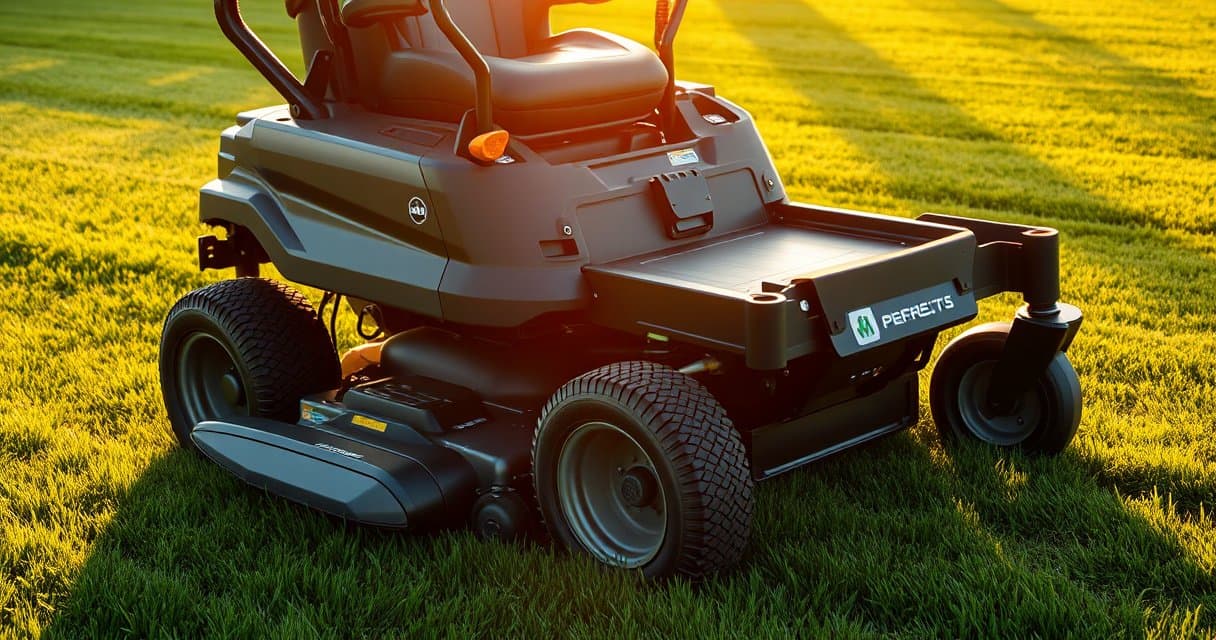
Choosing your ride-on lawn tractor is a bit like choosing a partner for the long hours spent in the garden: it needs to be up to the task. Imagine yourself finally free from the push mower, sitting comfortably, mastering your lawn. But to turn this image into a lasting reality, a few key points deserve your full attention. Don't be mistaken, the right model makes all the difference between a hobby and a chore.
Key Points to Remember
- Honestly assess the size and slope of your land first and foremost; this is the basis for choosing the appropriate power and transmission.
- Prioritize maneuverability and a practical cutting width for your access points rather than the widest raw performance.
- For a sloped terrain, a hydrostatic transmission is an essential investment for safety and comfort.
- Consider the long-term costs (fuel, maintenance, parts) and not just the initial purchase price.
- Comfort features (seat, controls, visibility) make all the difference during long mowing sessions.
Defining Your Garden's Needs: Area and Terrain
Before rushing to catalogs, ask yourself two fundamental questions: "How many square meters do I need to mow?" and "What is my terrain really like?". This is the only way to avoid a costly mistake. Too small, and the tractor will struggle and waste your time. Too big, and it will be unmanageable and waste your resources.
Start by measuring. Really.
We all tend to overestimate our area. Take out your phone, use a measuring app or an online tool like Google Earth. A 1000 m² lawn is already a good-sized rectangle of 20 m by 50 m. It's not insignificant. To give an idea:
- Less than 1000 m²? You might consider a good riding mower rather than a tractor. It will be more maneuverable and less expensive.
- Between 1000 and 3000 m²? That's the sweet spot for a tractor. Comfort becomes justified.
- Over 5000 m²? You're entering the territory of more robust and powerful machines, sometimes with a cutting width over 1 meter.
Don't rely solely on the raw area. A 2000 m² plot divided into several sections separated by paths or flower beds requires more maneuvering than a large uniform expanse.
The Terrain: Your Worst Enemy… or Your Best Ally?
This is THE criterion that can change everything in your choice. Flat terrain is easy. Everything else requires thought.
If your garden has moderate to steep slopes, you cannot leave anything to chance. Stability and power become priorities. Frankly, on a pronounced slope, a tractor that is too light or underpowered can become dangerous. It slips, struggles, it's stressful. You will need sufficient weight, appropriate lugged tires, and above all a performant transmission (we'll talk about that in the next section). A slope of 15° or more is already serious.
Here is a small guide to assess the complexity:
| Type of Terrain | Characteristics | Impact on Choice |
|---|---|---|
| Flat and Clear | Uniform surface, few or no obstacles. | The widest choice. Cutting width and comfort are your priorities. |
| Rolling | Gentle undulations, slight slopes (< 10°). | Need for good power reserve. Prioritize stable seating and precise steering. |
| Rough / Sloped | Marked slopes (> 15°), significant elevation changes, embankments. | Critical. High power, quality transmission (hydrostatic often essential), low center of gravity. Safety first. |
| Obstructed | Many trees, flower beds, narrow paths, obstacles. | Maneuverability paramount. Aim for a tight turning radius and a cutting width suited to your pathways. |
Don't forget the obstacles! A series of shrubs to navigate around, a 90 cm wide gate, exposed roots… These details will determine the necessary maneuverability. If your accesses are narrow, a cutting width of 1.20 m may be impossible to get through, no matter how performant it is. In this case, a narrower machine that goes everywhere is better.
Take the time to make this honest assessment. It's the foundation for everything else. Once you have these numbers and this precise description in mind, you can start looking at models with a real filter.
Comparing Powertrains: Gas, Electric, or Hybrid
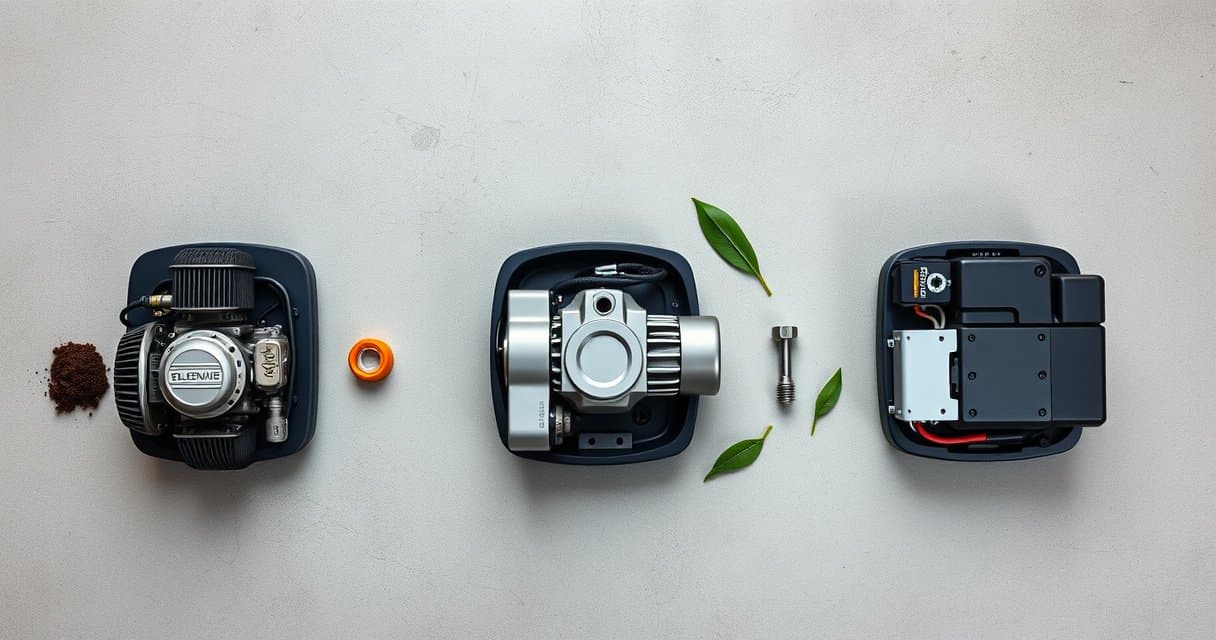
Now that you know your terrain, let's talk about the heart of the machine: its engine. This is a long-term commitment, both in terms of usage and budget. You don't choose an engine the same way for a small, well-maintained suburban lawn as you do for a multi-hectare estate with tall grass. Let me shed some light on the subject.
Gas: Raw Power and Unrivaled Autonomy
This is the historic standard, found on the vast majority of models, especially for large areas. Its strength? Often generous power and unlimited autonomy: you fill up the tank and you're set for hours, no matter the grass density. Perfect for terrains over 3000 m², especially if you have slopes or mow less frequently, when the grass is tall and damp. A good 500 cm³ gasoline engine will handle it without blinking.
But let's be honest: it's also the choice that requires the most maintenance. Oil changes, air and fuel filter replacements, spark plug... Not to mention the noise, vibrations, and emissions. And frankly, filling up with gasoline without getting your hands dirty is almost impossible. If you dislike mechanics or if your garden is in a densely populated residential area, this might not be your best ally.
Battery-Powered Electric: The Silent Revolution
This is the rising option, literally. No more noise (or almost none), no more smoke, no more gasoline to store. You plug the battery in the night before, you hop on in the morning, it's disarmingly simple. Startup is instantaneous, even in cool weather. Maintenance is practically limited to sharpening the blades and cleaning the machine.
So, what's the catch? Autonomy and power. Even with modern 80V batteries, you are limited by the capacity, expressed in Ah (Ampere-hour). For a flat, well-maintained 2000 m² terrain, no major issue. But as soon as you exceed 3000 m², or if your grass is dense or your terrain is sloped, the fear of running out of power mid-job looms. You also need to consider battery lifespan: it will lose capacity over the years, and its replacement represents a significant cost. It's a comfort vs. logistical constraint trade-off.
Hybrid? The Exception That Proves the Rule
This category is rarer. The idea is often to couple a small gasoline engine that acts as a generator to recharge batteries which, in turn, power the traction motor. Theoretically, it combines the autonomy of gas with the torque and smoothness of electric.
In practice, it's often complex and expensive. You inherit part of the maintenance of the gas engine (the generator-motor) along with the sophistication of an electric system. Unless you have a very specific need, I find it's a solution that sometimes combines the drawbacks of both worlds rather than their advantages. For domestic use, you can easily do without it.
How to Decide? A Question of Usage Philosophy.
Ask yourself these questions:
- "How much time, in one session, am I willing to spend on my mower?" If the answer is "as little as possible," a powerful gas mower on a large terrain will save you time. If it's "a relaxing hour," electric might suffice.
- "Am I set up to recharge a battery?" Having an outlet in your garden shed is almost a prerequisite for electric.
- "What is my budget over 5 years?" Gas often has a lower purchase price but ongoing fuel and maintenance costs. Electric is expensive to buy, very cheap to run, but with the possibility of a major battery replacement in a few years.
My opinion? For a standard terrain of 1500 to 3000 m², electric has become a serious and pleasant option. Beyond that, or if your terrain is a real challenge, the robustness and freedom of gas remain unmatched.
Our Selection
Today's selection takes on a true giant of gardening: the riding lawn mower. Designed for large plots, it promises to turn a chore into a moment of pleasure. We have scrutinized the technical specifications and dissected community feedback to present you with a model that seems to combine power and practicality.
| Product | Engine (kW/HP) | Cutting Width (cm) | Collection Bag (L) | Key Strengths |
|---|---|---|---|---|
| Scheppach MR225-61 | 4.4 / 6 | 61 | 150 | Hybrid start, large capacity, centralized adjustment |
Scheppach MR225-61
Let's analyze this Scheppach MR225-61 riding mower, which is clearly aimed at owners of large gardens, with a recommended area of up to 2600 m². On paper, the specs are impressive: a 4-stroke petrol engine of 4.4 kW (6 HP), a generous cutting width of 61 cm, and a huge 150-litre collection bag. What interests us here is the promise of efficiency and autonomy for quick and less frequent mowing.
Drawing on user feedback, several strengths stand out. The hybrid start (electric or pull-start) is often praised as a real advantage for effortless starting. The community also notes that the large pneumatic tires provide good stability and traction, even on slightly rough or sloped terrain. The centralized cutting height adjustment (from 35 to 75 mm) is considered practical for adapting to different seasons without having to adjust each wheel. Finally, the presence of four forward speeds allows adaptation to the type of grass and lawn density.
However, an honest analysis must also consider reported limitations. Its robust design and large bag result in a significant weight (over 140 kg), which can complicate storage or navigating very tight spaces. Some reviews point out that for land with very sinuous contours or scattered with many obstacles, the maneuverability of a riding mower of this size may require an adjustment period. As with any petrol engine, regular maintenance (oil level, spark plug, air filter) is essential to guarantee its longevity and performance, a point to anticipate compared to an electric machine.
In conclusion, the Scheppach MR225-61 presents itself as a robust and very efficient solution for large, flat or slightly sloped areas. Its strength lies in its ability to handle large expanses quickly, thanks to its wide cut and large bag. It suits a user primarily seeking productivity and having storage space suited to its size. For gardens of more modest size or with very rugged terrain, its format could prove disproportionate.
Selecting a Transmission Suited to Your Terrain
If the engine is the heart, the transmission is the legs of your tractor. It converts power into motion, and above all, into control. A poor transmission on rough terrain guarantees a frustrating, even dangerous, driving experience. This is a technical point often underestimated, but one that makes a colossal difference in day-to-day use.
Manual Gear Transmission: The Simplest (and Most Demanding)
This is the oldest system. You have a gear lever, a clutch (often a pedal), and you change gears manually, like in an old car. The advantage? Mechanical simplicity, often synonymous with reliability and moderate repair costs. It's a good option if you have perfectly flat terrain, a modest area (let's say up to 3000 m²), and you don't mind working the pedals and lever.
But frankly, on hilly terrain or for long sessions, it quickly becomes tiring. Imagine having to downshift on a climb, managing the clutch on a tight turn... it's not very intuitive. For me, this type of transmission is really only for small budgets and terrain without significant slopes.
Automatic Transmission (CVT): The Basic Comfort
Here, no more clutch or gears to choose. You simply use one pedal for forward, one for reverse (or a single lever for direction), and the machine manages the gear ratio automatically. It's a big step forward in terms of ease of use. It's much less tiring, especially if you have frequent back-and-forth movements, maneuvers, or gentle slopes.
The downside? It's a bit less effective on steep slopes than other systems and can tend to "slip" if subjected to heavy strain. It's perfect for the majority of medium-sized gardens with moderate slopes. It's the good comfort/price compromise.
Hydrostatic Transmission: The Ultimate for Control
This is the Rolls-Royce of driving for a lawn tractor. The principle? A steering wheel or two levers control speed and direction in a perfectly smooth and infinitely variable way, without jerks. You have millimeter-precise control of your speed, which is invaluable for sloped, uneven terrain, or when you need to maneuver precisely around flower beds.
On a slope, you can maintain a constant, slow speed without fear of the machine racing or stalling. It's also much safer. The major drawback is the price: this technology is more expensive to buy and potentially more complex in case of a breakdown. But for terrain over 5000 m² with elevation changes, it is, in my opinion, non-negotiable. It's the investment that makes mowing truly enjoyable.
The Special Case of ZTR (Zero Turn Radius) Models
Here we are talking about another category, with a transmission via independent dual hydrostatic levers controlling each of the rear drive wheels. This allows for turning on the spot and incredible agility for weaving between trees. It's great for complex terrain with many obstacles.
But be careful, getting the hang of it requires a bit of a learning curve, and it's not necessarily ideal on steep side slopes, where stability can be worse than on a classic tractor. It's a choice to make if maneuverability is the top priority.
Concretely, how to choose? Stand in front of your garden. If you see marked slopes (>10%), a lot of elevation change, or if your land is very large, aim for hydrostatic. If your garden is rather flat, well open, and medium-sized, the automatic (CVT) will do very well. I only recommend the manual if the budget is very tight and the terrain is easy. Don't skimp on this point: a good transmission guarantees finishing the mow less tired... and with a smile.
Choosing Cutting Width and Grass Management System
The cutting width is your main time saver. The grass management system is what will determine what you do after mowing. These two elements are linked and must be considered together, based on your gardening style.
Cutting Width: Finding the Right Compromise
Basically, the wider the blade, the fewer back-and-forth passes you make. But be careful, it's not a race for the widest cut. Here's how to think about it.
For a garden with many narrow passages between flower beds, a hedge, or a gate less than a meter wide, a cutting width of 75 to 90 cm is often the maximum practical. Measure your passages! A machine that is too wide will force you to perform difficult maneuvers or to use a push mower to finish the edges. It's counterproductive.
For an open lawn of 3000 to 5000 m², a width of 100 to 110 cm is often ideal. It offers good efficiency without being cumbersome.
Beyond 5000 m², you can consider models with 120 cm and wider. But here, you need a really open terrain, a garage wide enough for storage, and a budget to match. These large widths also require a suitably powerful engine to drive the blade without strain.
My advice: always prioritize practicality over raw performance. A 100 cm machine that goes everywhere is better than a 120 cm one that gets stuck at every turn.
Mulching, Bagging, or Side Discharge: What to Do with the Grass?
This is where your choice has a direct impact on your routine and the health of your lawn.
Side discharge is the simplest mode. The machine ejects the cut grass to the side, often into a removable bin that you empty afterwards. It's perfect if you like an impeccable lawn, without clippings, or if you compost your green waste. But it implies stopping every 20-30 minutes to empty the bin, and additional work for disposal. On a large plot, this considerably lengthens mowing time.
Full mulching is a real revolution. A special blade and a deck designed to keep grass blades suspended cut and re-cut them into fine particles, which fall back invisibly onto the soil. It's a phenomenal time saver: you never stop to empty. These particles act as a natural fertilizer as they decompose. The real advantage is passive fertilization and time saved. The drawback? It requires more frequent mowing (never cut more than one-third of the grass height) and an effective mulching system. On low-end models, the grass is poorly chopped and can suffocate the lawn.
Hybrid or 3-in-1 systems allow you to choose between side discharge, mulching, and sometimes even bagging, depending on the season or the condition of the grass. It's flexible, but often involves changing parts (a plug to block the discharge chute, a specific blade...). In my opinion, it's the best choice if you're undecided or if your grass is sometimes too tall for clean mulching.
One last practical point: if you mow once a week and like the idea of a self-sufficient garden, head towards a good mulching system. If you tend to let the grass grow and want to clean everything up, or if you have waste to remove, bagging with a large bin will be your friend. Don't underestimate this choice, it really changes the mowing experience.
Balancing Purchase Budget with Long-Term Costs
The sticker price is only the first chapter of the story. The real question is: how much will it cost you, each year, to keep it running? Ignoring this calculation is risking ending up with a nice machine that sits in the garage because a replacement part costs a fortune or its fuel appetite is excessive.
The Hidden Cost #1: Consumption and Routine Maintenance
Let's talk fuel. A 500 cc combustion engine tractor can easily consume between 1.5 and 2.5 liters per hour. Multiply that by your annual mowing hours. Over a 50-hour season, at €1.80 per liter, you're already spending between €135 and €225 just for gasoline. An electric model, on the other hand, "refuels" for a few euros on your electricity bill. It's a simple calculation but often forgotten.
Then there is mandatory maintenance. Oil, air filter, fuel filter, spark plugs... Budget for a basic annual maintenance kit between €80 and €150 for a combustion model, if you do it yourself. At a dealership, add labor. An electric model eliminates most of these items, but you'll need to plan for replacing the high-voltage battery after 5 to 8 years, an investment that can represent 15% to 25% of the machine's initial price. Always ask for the price of this replacement battery before buying.
Wear Parts: Blades, Belts, and Tires
These are the consumables of your tractor. A standard cutting blade can cost from €30 to €100 each depending on size and quality, and it's recommended to sharpen or replace it at least once per season, or more if you encounter stones. A main drive belt can represent a cost of €100 to €250, plus labor if you're not a handyman. Check their accessibility: on some models, replacing a belt requires taking half the machine apart, tripling the garage time. Tires also wear out. Aggressive lugged tires are perfect for slopes but wear out faster on the asphalt of driveways. Prioritize models with standard inner tubes, whose tires are cheaper and easier to replace than solid or complex-structure tires.
Resale Value and Parts Availability
Here, the brand makes a tangible difference. A reputable brand with a solid distribution network will maintain a much higher resale value than a discount brand. Research the availability of spare parts in your region. Having to order a simple fuel pump from the other end of Europe with a three-week lead time guarantees seeing your lawn turn into a meadow. My recommendation? Allocate about 15% to 20% of the purchase price to a working capital fund for the first two years of maintenance and consumables. If this calculation makes you hesitate between two models, choose the less greedy and simpler to repair one. Peace of mind is priceless.
Checking Equipment for Daily Use Comfort

A tractor is an investment of time. You will spend dozens of hours per season on it. Equipment are not gadgets; they are the elements that transform a chore into a nearly pleasant, or at least bearable, moment. Overlooking this point risks you coming to hate a machine that is otherwise perfectly capable.
The Operator's Station: Your Cockpit for the Next Two Hours
Start with the seat. A basic foam seat compresses and becomes uncomfortable after 30 minutes. Look for a seat with spring suspension and an adjustable backrest. A wide ergonomic seat (at least 45 cm) makes all the difference on bumpy terrain. Next, the controls. A hydrostatic transmission is a must for comfort; you control speed with a simple pedal, without having to operate a clutch in every turn. Check the layout of the levers: the mower lift lever and the engine speed selector must be accessible without having to contort yourself. On some models, they are poorly placed behind the steering wheel – a real nightmare in practice.
Cutting Control and Visibility
You shouldn't have to constantly turn around to check your work. A clear indicator light signaling that the bag is full is valuable. Even better: a 100% fill system that slightly raises the blade when full to prevent clogging wet grass under the deck. Visibility to the front and sides is crucial. Powerful LED headlights are essential if you sometimes have to mow in the late afternoon, when dew is falling. And let's talk about noise. A good muffler and a well-insulated hood can reduce engine noise by several decibels. It seems minor, but after two hours, the difference between 95 and 88 dB translates to much less fatigue and better relations with your neighbors.
The Little Extras That Change Everything
Don't neglect them. A cup holder? Vital. A secure storage space under the seat for an Allen key, gloves, or your phone? Practical. Deck lighting to see under the mower deck? A luxury that becomes necessary when checking for a blockage. My advice? Insist on a real 15-minute test drive at the dealership. Sit down. Operate all the levers. Simulate a tight turn. That's when you'll feel if the machine is designed for the human who will drive it, or simply assembled to meet a specification sheet. Comfort is not a luxury; it's what ensures you will use your machine regularly and correctly.
Conclusion
Choosing your riding lawn mower is a decision that should mature. Do not rush for the first offer.
Weigh each criterion against the realities of your garden and your way of working. A well-suited machine almost disappears, making way for the simple pleasure of a perfectly maintained lawn.
Take your time, do your tests, and invest for the years to come. Your back and your free time will thank you.
Frequently Asked Questions
What cutting width for a 3000 m² area?
For a 3000 m² lawn, a cutting width of 100 to 110 cm offers a good balance between efficiency and maneuverability. First, check the width of your narrowest passages to ensure the machine can navigate them.
Manual or hydrostatic transmission for a sloped terrain?
For terrain with marked slopes (>15°), hydrostatic transmission is essential for safe control and consistent speed. A manual transmission would be too demanding and potentially dangerous on this type of terrain.
Should I choose a thermal or electric tractor?
Thermal is ideal for large areas (>3000 m²) and demanding terrains due to its power and unlimited autonomy. Electric is suitable for well-maintained areas of 1500 to 3000 m² and offers quiet operation with very low maintenance.
What is the advantage of the mulching system?
Mulching finely shreds the grass and distributes it on the lawn, which acts as a natural fertilizer and saves time by avoiding stops to empty a collection bag. However, it requires more frequent mowing to be effective.
How to choose correctly based on the terrain's slope?
Assess the inclination: for slopes greater than 15°, prioritize a heavy tractor with hydrostatic transmission and lugged tires for stability. On flat terrain, you have the widest choice, with cutting width and comfort becoming priorities.
Is a tractor justified for less than 1000 m²?
For an area less than 1000 m², a ride-on mower is generally more suitable, being more maneuverable and economical. A lawn tractor would be disproportionate and less practical for maneuvering in tight spaces.
100% free and independent — All our articles are written independently, without any sponsorship. We may earn a commission on purchases made through our links, at no extra cost to you.
Guides you might like
Buying Guide: Choosing Your Thermal Brushcutter
Guide to choosing a thermal brushcutter: Compare 2-stroke vs. 4-stroke engines and harness types for effective clearing of brambles and sloped terrain.
Ultimate Guide to Gas Mowers
Petrol lawnmowers provide power & autonomy for large lawns over 500 m². Key features & selection criteria for your garden explained.
Best Cordless Lawn Mower
Enjoy lawn care freedom: silent, instant-starting cordless mowers. Key tips on battery runtime & power selection for your perfect match.
Articles you might like
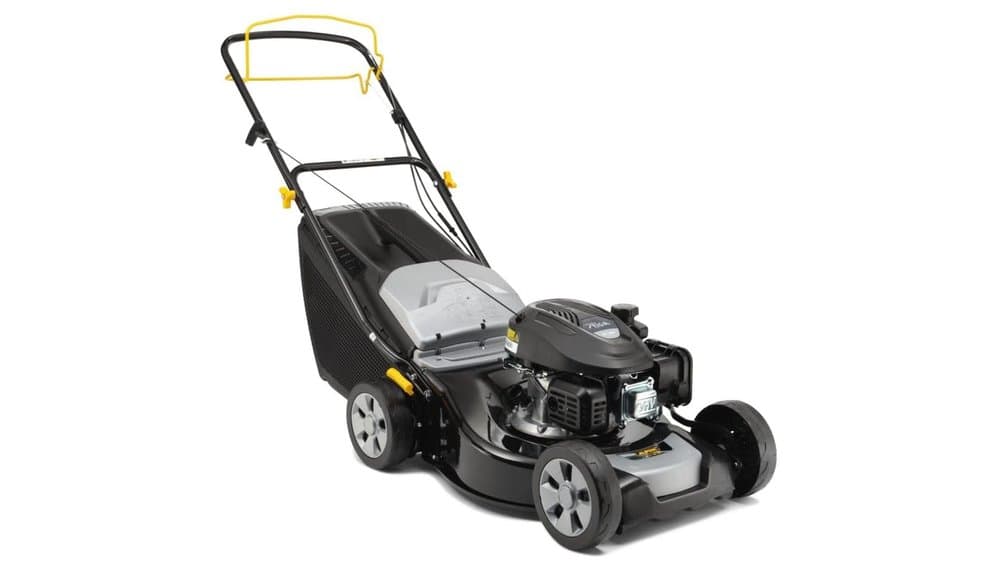
Alpina AL4 46 SA Petrol Lawnmower Review & Test
Alpina AL4 46 SA review: A robust, self-propelled petrol mower for medium to large gardens. We analyze its specs, performance, and user feedback.
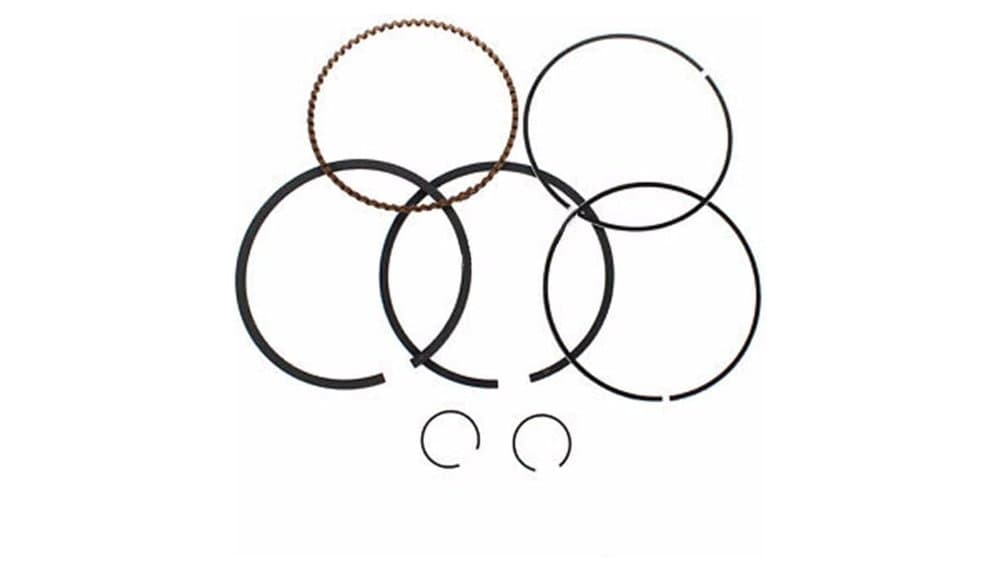
LIZONGFQ GX390 Engine Rebuild Kit Review
Restore performance: Rebuild your Honda GX390-type lawn mower engine instead of replacing the entire machine with cost-effective repair parts.
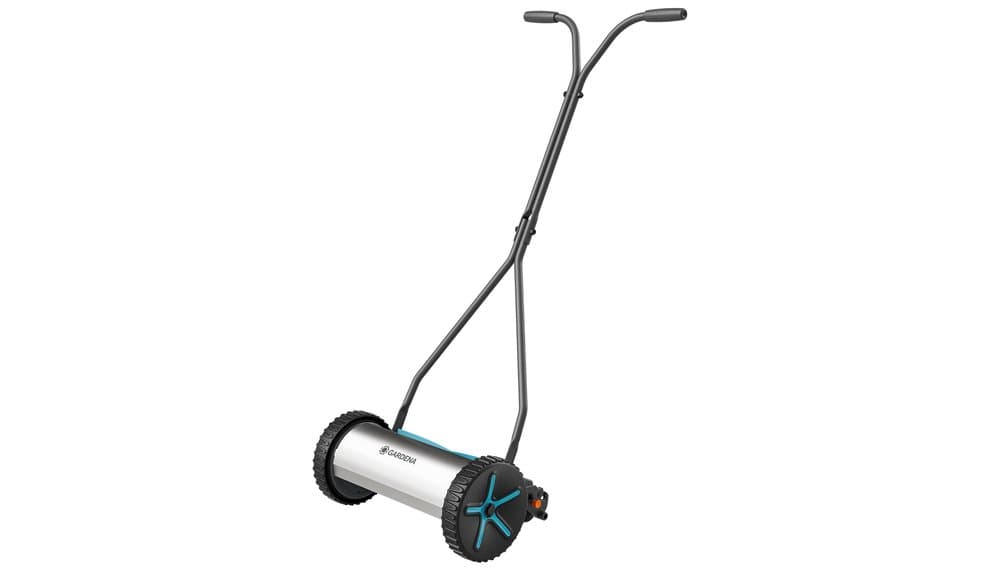
Gardena Comfort 330 Manual Lawn Mower Review and Test
No engine, no battery. This manual cylinder mower offers a quiet, eco-friendly cut for small lawns, delivering quality like an English green.