Ultimate Guide to Gas Mowers
Frankly, when your lawn is more than a few hundred square meters, struggling with a corded electric mower or a battery that dies mid-effort is no longer an option. You need brute power and flawless autonomy. A petrol lawnmower is then the ideal partner for this job, but not all are equal and the choice depends primarily on your garden.
Key Points to Remember
- A petrol lawnmower is ideal for surfaces exceeding 500 m², especially if the terrain has slopes or requires powerful cutting.
- Choose a 4-stroke engine and adapt the displacement to your surface area: 125-140 cm³ up to 1000 m², and 160-190 cm³ for larger or sloping terrain.
- Opt for features like self-propulsion on rough terrain and centralized cutting height adjustment for more comfort.
- Rigorous maintenance (oil change, air filter, sharpened blade, and fuel management in winter) is crucial for the longevity and reliability of the machine.
- Petrol mowers are not suitable for small urban gardens, for users unwilling to perform mechanical maintenance, or in areas with strict local noise regulations.
Analyze Your Terrain: The First Criterion for Choice
Even before looking at the brand or price, look out the window. Your garden is in command. It's a bit like choosing a car: you don't take a 4x4 for grocery shopping in the city, nor a compact car to cross fields.
Surface Area: The Numbers That Guide Your Purchase
We often read "for large areas". But what is a large area? In my opinion, a petrol mower becomes truly relevant from 500 m² upwards. Below that, a high-performance battery-electric model can often do the job. But if you exceed 800-1000 m², petrol power becomes essential for its ability to do everything in one go without a recharging break.
A quick practical calculation: a mower with a 46 cm cut (that's the width of the blade) will "swallow" about 0.46 meters in width with each pass. To mow 1000 m² of a well-rectangular lawn without obstacles, you are already walking several kilometers. This is where comfort comes into play.
Slope, Obstacles, Access: Manoeuvrability at Stake
The surface area is one thing. But the topography is another. Even a slight slope, of 10-15% for example, can become a real ordeal with a heavy, simply push-propelled machine.
- Pronounced Slope (>10%): Frankly, forget a simple push mower. You need a self-propelled model. It's non-negotiable. The engine drives the wheels, you guide it, you don't push it. You save your back and cut your effort time in half.
- "English-style" Garden with Beds and Trees: A very divided space requires manoeuvrability. A cutting width that's too large (53 cm or more) will be a handicap between your rose bushes and your apple tree. Opt for a narrower machine (40-46 cm) with front swivel wheels. It makes all the difference for weaving around.
- Narrow Access or Gate: Measure the width of your passages! Nothing worse than having to tilt the machine at a 45° angle to get it into the garage because it's 5 cm too wide.
The Nature of Your Lawn
Grass isn't always tender and fine. If you have a meadow you just want to keep under control, or a very dense ornamental lawn, the engine power should not be overlooked. Terrain that is regularly damp or with tall, thick grass requires solid torque to prevent the engine from stalling under load. We'll talk about engine displacement in the next section, but remember this for now: a small engine on a large, bumpy, and grassy terrain is a guarantee of premature wear and frustration with every use.
In short, take a tape measure, evaluate the slopes, and be honest about the frequency and nature of your mowing. This honest assessment will save you from 90% of buying mistakes.
Understanding Mechanics: Engines, Power, and Fuel
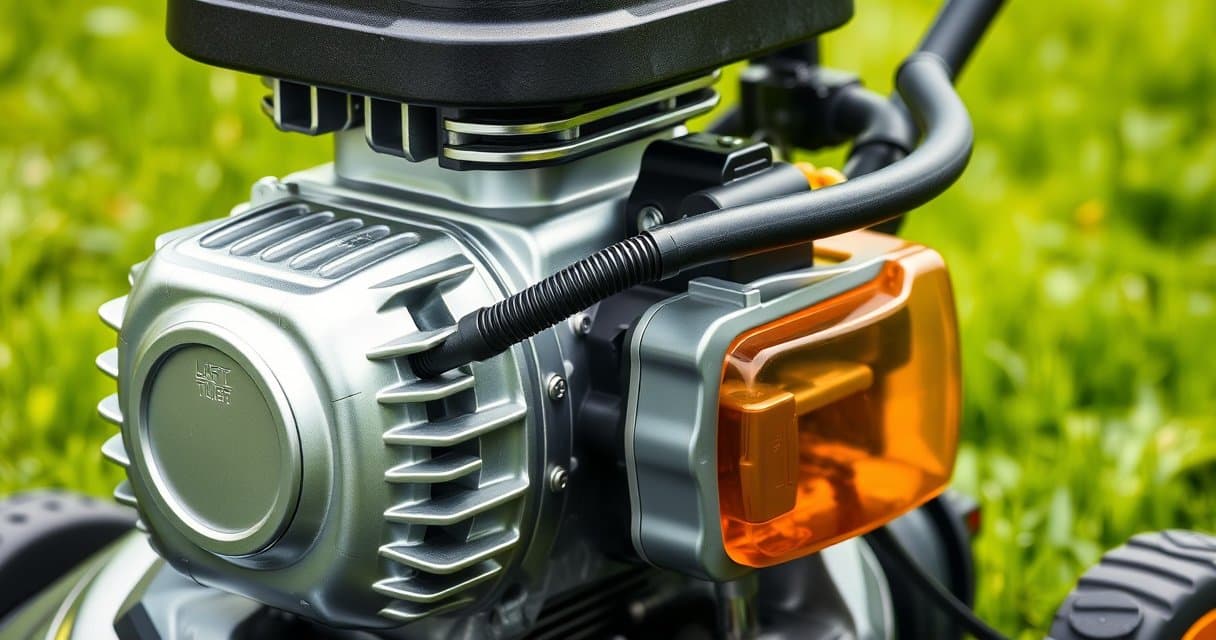
Now, let's look under the hood. This is what makes the difference between a machine that purrs for ten years and one that sputters by the second season. Let's talk technical, but without useless jargon.
4-Stroke vs. 2-Stroke: The Question is (Almost) Settled
Unless it's a very specific case, your petrol lawnmower will have a 4-stroke engine. Why? It's simple: it has a separate fuel tank and an oil sump. You fill it with gasoline without any oil mixture, and you check/change the oil periodically. It's cleaner, more fuel-efficient, more reliable, and less noisy. 2-stroke engines (where you have to mix oil with the fuel) have almost disappeared from lawnmowers, and that's a good thing. Don't complicate your life.
Displacement and Power: The Horses Under the Hood
The displacement, expressed in cm³ (cubic centimeters) or cc, gives you a good idea of the engine's "size". As a general rule:
- For a standard family garden up to 1000 m², a 125-140 cm³ engine is often sufficient.
- For an area of 1500 m² or more, with slopes or thick grass, aim for 160-190 cm³.
Power is often given in HP (horsepower) or kW. A good indicator for demanding use is to aim for at least 4 kW (about 5.5 HP). A slightly oversized engine for your lawn will work less "flat out", reducing wear and ensuring better longevity. It's a wise investment.
Fuel: Unleaded Gasoline, and Then What?
You go to the gas station and fill up with SP95-E10 or SP98. That's the minimum. But the real trap is the age of the gasoline. In your mower's tank, modern gasoline degrades in a few weeks. It forms gummy deposits that clog the carburetor. This is the leading cause of failure at spring restart.
My radical advice? Two options:
- Either you completely empty the tank and the carburetor before winter storage (we'll come back to that in maintenance).
- Or you use a specific stabilized fuel, sold in cans at hardware stores. It is designed to last for months without degrading. It's more expensive per liter, but so much simpler and cheaper than a carburetor overhaul.
Manual vs. Electric Start: Comfort Comes at a Price
The pull-cord starter is the classic. It requires a bit of technique (a firm pull, not in short jerks) and strength if the engine is cold. Electric start, on the other hand, changes everything. You turn a key or press a button, and it starts. Essential if you are not very handy or lack arm strength. Be careful however: this system uses a small battery (usually 12V) that sometimes needs to be charged occasionally. It's a bit more maintenance, but for many, it is well worth it.
Our Selection
Looking for the perfect petrol lawnmower for your garden? Scheppach, a recognized brand in the gardening world, offers robust and versatile machines. We have analyzed three of their flagship models to help you make an informed choice. Based on the technical specifications and community feedback, here is our comparative selection.
Comparison Table
| Product | Engine | Cutting Width | Grass Collection Box | Key Strengths |
|---|---|---|---|---|
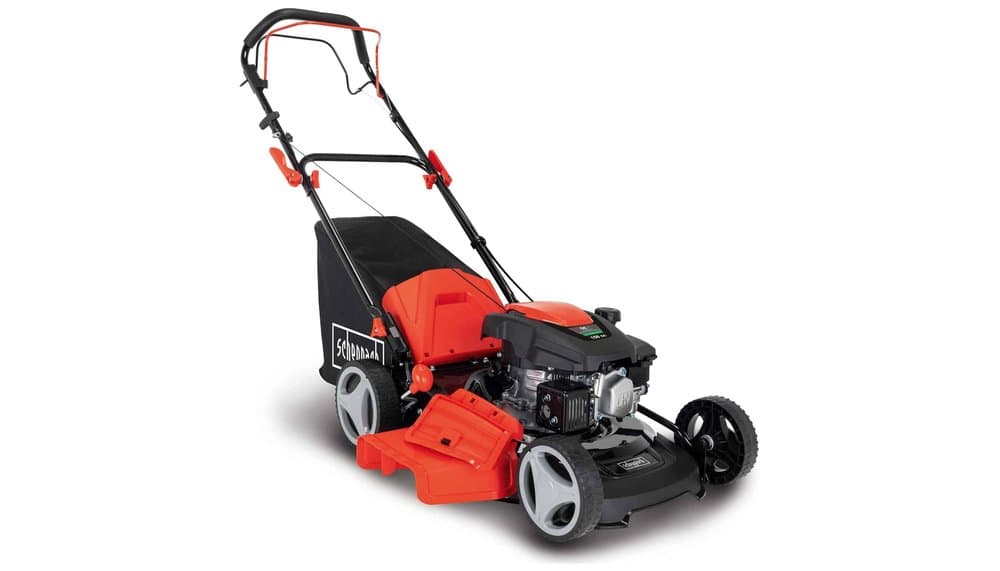
| Scheppach MS161-46 | 150 cm³ | 46 cm | 55 L | Lightweight, maneuverability, entry-level price |
| Scheppach MS225-53E Hybrid | 224 cm³ | 53 cm | 65 L | Electric start, traction, power |
| Scheppach MS175-51 | 173 cm³ | 51 cm | 65 L | 6-in-1 versatility, high torque |
Scheppach MS161-46
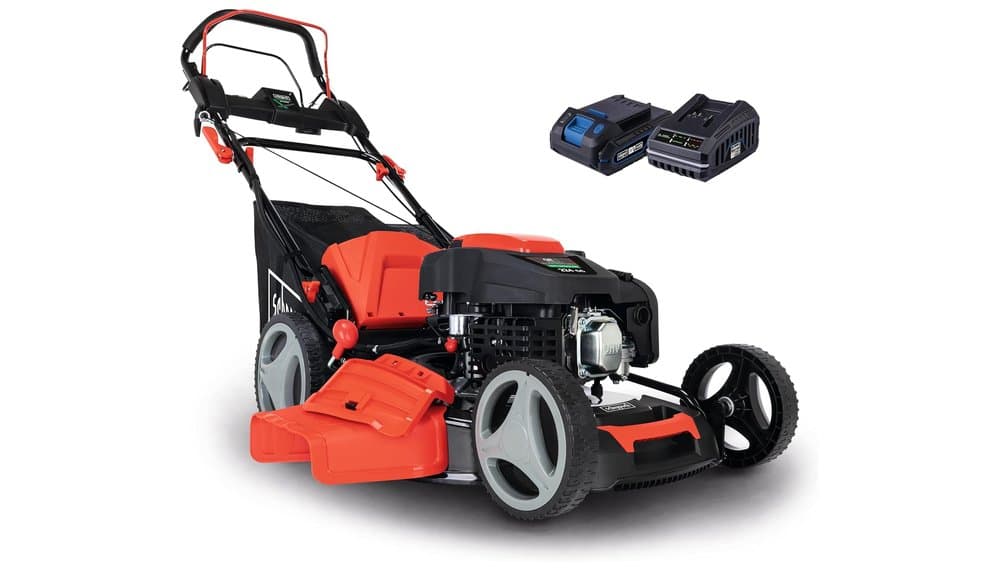
The MS161-46 presents itself as the entry-level model in this selection, ideal for medium-sized gardens. Its 4-stroke 150 cm³ engine is described as powerful enough for standard use. The gardening community particularly appreciates its maneuverability, thanks to its contained weight (around 27 kg) and large wheels, which make it easy to push, even without assisted traction. The 46 cm cutting width is a good compromise for efficient passes without being too bulky.
User feedback highlights the versatility offered by the collection (55L grass box), side discharge, and mulching functions. The central adjustment system for cutting height in 7 positions is judged to be practical. However, some reviews point out that for sloped or very large areas, the lack of assisted traction can become a drawback, making this model a machine better suited to flat or slightly inclined gardens. Its strong point lies in its simplicity/price ratio, offering essential functions without frills.
Scheppach MS225-53E Hybrid
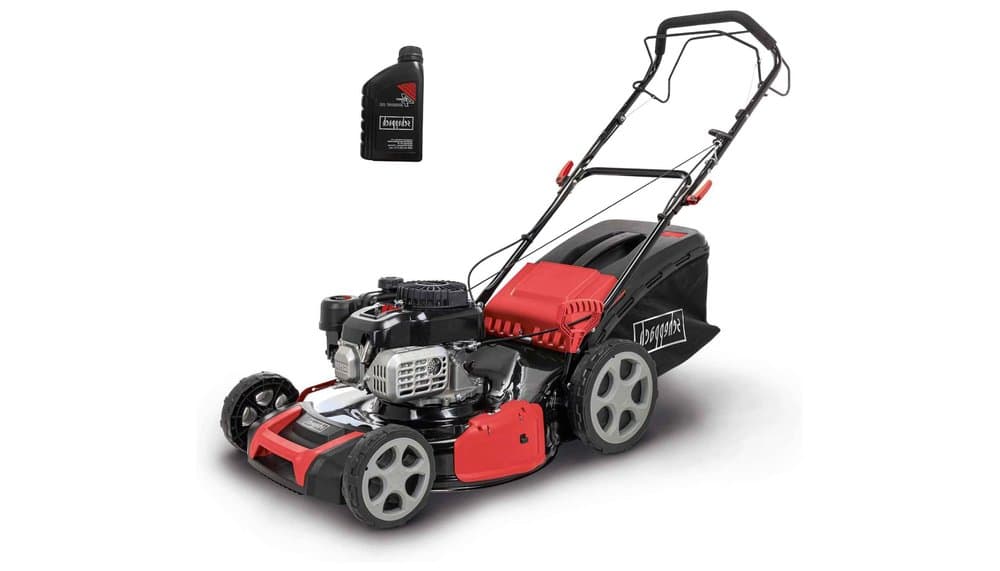
The MS225-53E Hybrid model clearly targets owners of large gardens (up to 1800 m² according to the manufacturer) and those seeking maximum comfort. Its main asset, according to the specifications, is its electric start via battery, saving the traditional and sometimes difficult manual pulls. Coupled with a 224 cm³ engine, it is the most powerful machine in our selection.
Reviews converge in praising its assisted traction, a real plus for sloping terrain or long mowing sessions, significantly reducing fatigue. The generous 53 cm cutting width and the large 65-liter grass box allow for covering large areas quickly and with fewer stops. Users confirm its robust character and suitability for intensive work. In return, this performance and these features translate into greater weight and size. It is the ideal investment for those who prioritize productivity and ease of use on a large plot.
Scheppach MS175-51
The MS175-51 positions itself as a versatile and durable machine. Its 173 cm³ engine, although slightly less powerful than the Hybrid model's, benefits from a professional transmission touted for high torque, useful in dense or wet grass. Its particularity is its "6-in-1" function (mowing, collecting, mulching, side discharge, etc.), offering great flexibility of use depending on the season and preferences.
Community feedback notes that its 51 cm cutting width and 65-liter grass box make it an efficient machine for significant areas. The ability to adjust the cutting height across 8 levels is also appreciated. However, with a slightly lower average rating than the other models (3.7/5), some users point out ergonomics or finish details that could be improved given its positioning. It represents a good choice for those primarily seeking robustness and versatility for a demanding garden.
Features that Transform the Mowing Experience
Raw power is one thing. But what truly makes the difference between a chore and a nearly pleasant task are the practical options. Some save you from backaches, others save you precious time. Here are the ones that truly matter.
Self-Propulsion: Your Ally Against Fatigue
On hilly terrain or simply from 700-800 m² onwards, pushing a heavy machine quickly becomes tiresome. The self-propelled function is a game-changer then. A simple trigger or a dial on the handlebar activates the drive of the rear wheels. You only have to accompany the mower and guide it. The difference at the end of the day is huge for your shoulders and back. Just make sure the drive speed is adjustable, so you don't get pulled too fast on a slope.
A Well-Designed Collection Bag
Capacity is important: a 55-liter bag will prevent you from having to empty it every 200-300 m² if your grass is thick. But also look at its attachment and emptying system. Robust clips are better than fragile plastic systems that break. Ideally, the bag detaches with one hand and empties from the top like a wheelbarrow, without you having to lift it. A transparent fill-level gauge is a very appreciated little luxury.
Cutting Systems: Collection, Mulching, Side Discharge
Your mower must be able to adapt to your routine. Most models offer three modes.
- Collection: The grass is cut and directed into the bag. This is the neatest mode, essential at the start of the season or after a rainy period when the grass is tall.
- Mulching: The special blade and closed deck finely chop the grass clippings and redeposit them on the ground as natural fertilizer. It saves a ton of time (no emptying) and is excellent for your lawn, but it only works well on regularly mowed, dry grass.
- Side Discharge: You mow without the bag and the grass is discharged to the side. Perfect for a first very high cut in a field or for clearing a neglected area.
Frankly, a machine that offers these three options via simple flaps to manipulate is a must. It will serve you well in all situations.
Centralized Cutting Height Adjustment
Forget individual levers on each wheel! It's a real hassle to get a uniform height. Centralized adjustment, via a single lever or dial, allows you to adjust the height of all four wheels simultaneously, often between 20 and 90 mm. You switch from a sporty cut to summer mowing in two seconds, without bending over. For me, it's non-negotiable on a modern mower.
Regular Maintenance for a Reliable and Durable Machine
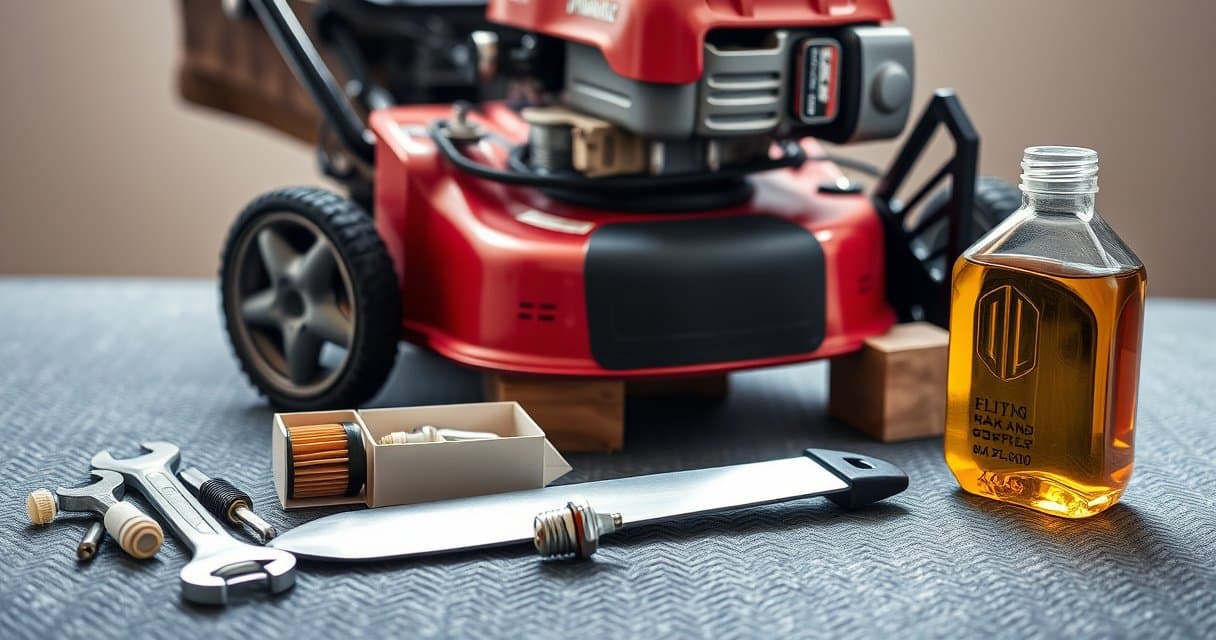
It's the big secret: a well-maintained gas mower can last ten or fifteen years without fail. Conversely, neglecting it ensures difficult starts and premature failure. Maintenance isn't rocket science, but you must be thorough. Follow these steps.
After Each Use: The 5-Minute Ritual
Never put away the machine covered in wet grass, as that guarantees rust. Turn off the engine and disconnect the spark plug for safety. Tip the mower over (carburetor side up!) and scrape the underside of the deck with a small wooden or plastic tool. Accumulated grass reduces cutting efficiency and clippings discharge. Next, a quick blast of air or a dry cloth on the air filter and top of the engine is sufficient. This micro-habit makes all the difference over time.
Seasonal Maintenance: Oil, Filter, and Blade
This is the core of the matter. At the start of the season (or after the first 25 hours of use), three actions are vital.
- Change the engine oil. The oil change should be done with a warm engine so the oil drains properly. Use exactly the grade recommended in the manual (often SAE 30 or 10W-30). Don't just top it off; drain and refill.
- Inspect and clean the air filter. A clogged filter chokes the engine and increases fuel consumption. Tap it gently to remove dust, or better yet, replace it if it's really dirty. It's an inexpensive but crucial part.
- Sharpen or replace the blade. A dull blade shreds the grass instead of cutting it cleanly. The result? Yellowed tips, stressed lawn, and increased susceptibility to disease. Remove the blade, have it sharpened by a professional, or replace it outright if it's bent or damaged. Sharpening once per season is a good rhythm.
Winterizing: The Preserving Rest Period
This is where most wintertime breakdowns occur. Before long-term storage, two schools of thought exist, but only one is 100% safe in my opinion.
- The radical method (my recommendation): Run the engine until the tank is empty. Then drain the last bit of fuel with a funnel. This way, no old fuel will gum up the carburetor as it dries out.
- The alternative: Add a fuel stabilizer to a full tank, run the engine for 5 minutes to circulate it, then turn it off. In both cases, change the oil if you haven't already. Store the machine in a clean, dry place, if possible with the tires raised to prevent them from becoming deformed.
Small Actions That Prevent Big Problems
A few simple habits. Always use unleaded gasoline, and if possible, use special "garden tool" fuel (ethanol-free) to prevent damage to seals and lines. Check the tension and condition of the starter cord from time to time. And above all, keep your user manual handy! It contains the precise maintenance schedule for your model and the list of replacement parts.
When Gas-Powered Isn't the Ideal Solution
I love the raw power of a good gas-powered mower, let's be clear. But you also have to be honest: in certain situations, it becomes a problematic choice, or even downright unsuitable. Realizing this after the purchase is a double whammy. Here are the cases where you really need to think twice.
For Small Urban Gardens or Grassy Patios
Imagine a 100 m² city garden, surrounded by walls, with close neighbors. Bringing out a gas mower means triggering a 95-decibel racket that will echo throughout the entire block and earn you the wrath of the neighborhood. Not to mention the smell of gasoline and fumes in a confined space. For such a modest area, a high-end battery mower (with a voltage of 36V or more) will do the job in 15 minutes, quietly, and without bothering you with fuel. It's a choice of common sense and good neighborliness.
If You Absolutely Hate Mechanical Maintenance
Let me be direct: if the idea of changing the oil, storing gasoline, and planning a winterization service gives you hives, move on. A gas mower will resent you for that neglect. It will refuse to start in the spring. A robotic mower, even with its initial setup, or a battery-powered electric mower, will offer you much greater peace of mind. You're trading mechanics for electronics and charging logistics. It's up to you to see what suits you best.
In Case of Very Steep Slopes or Rough Terrain
It may seem counterintuitive, because we often associate gas-powered with power. But on a very steep slope, the weight of a gas machine becomes a real danger. A heavy self-propelled mower can become difficult to control going downhill, and pushing it back up by hand is an ordeal. For extremely steep terrain, a robotic mower specifically designed for steep slopes (some models handle up to 35% or 75% depending on the technology) can be a much safer and more passive solution. For bumpy and rough terrain, the large front wheels of a battery-powered self-propelled electric mower sometimes offer better flexibility and grip than a heavy, rigid gas-powered chassis.
Facing Strict Local Regulations
Do your research! More and more municipalities, especially in sensitive peri-urban areas, are imposing very restrictive time slots for the use of gas-powered tools, often limited to weekday afternoons. If you can only mow on Saturday morning, your beautiful gas mower could become a decorative element in the garage. An electric or robotic mower gives you back the freedom to mow early in the morning or in the evening without conflict. It's a purely practical parameter, but it can decide everything.
For Very Occasional Use or a Second Mower
Buying a gas mower to use it three times a year is the worst thing you can do. The fuel will age and clog the carburetor, the seals can dry out. It's the perfect scenario for a breakdown every time you use it. For a secondary residence where you only mow in spring and fall, a battery mower with two batteries, or even a good corded mower for small areas, will be more reliable and less demanding in the long run. Simplicity wins out over power here.
Conclusion
As you've seen, choosing a gas-powered mower is a balancing act. You must weigh power against maintenance, versatility against regulations.
Listen to your land. And above all, listen to yourself.
A good mower serves you for years. It should be an ally, not a chore. Take your time, check your real needs.
The best machine is always the one that fits your reality.
Frequently Asked Questions
What size lawn justifies buying a gas-powered mower?
A gas-powered mower becomes truly relevant starting from 500 m² and is essential for surfaces exceeding 800-1000 m², as it provides the power and autonomy needed to handle everything in one go.
How to choose the engine displacement of a gas-powered mower?
For a standard garden up to 1000 m², an engine of 125-140 cm³ is often sufficient, while for 1500 m² or more with slopes, you should aim for a displacement of 160-190 cm³.
What is the main advantage of a self-propelled gas-powered mower?
The self-propelled function is essential on sloped terrain (from 10% slope) or starting from 700-800 m², as the engine drives the wheels, which avoids having to push the machine and significantly reduces fatigue.
How to avoid starting failures in spring with a gas-powered mower?
The primary cause of failure is old gasoline clogging the carburetor; you must either completely drain the tank and carburetor before winter, or use a specific stabilized fuel designed for long-term storage.
When should you not choose a gas-powered mower?
It is not recommended to choose a gas-powered mower for a small urban garden (< 100 m²) due to noise and emissions, or if you dislike mechanical maintenance like oil changes and fuel management.
What maintenance should be done on a gas-powered mower at the start of the season?
Crucial seasonal maintenance includes changing the engine oil (with a warm engine), cleaning or replacing the air filter, and sharpening the blade for a clean cut and a reliable engine.
100% free and independent — All our articles are written independently, without any sponsorship. We may earn a commission on purchases made through our links, at no extra cost to you.
Guides you might like
Buying Guide: Choosing Your Thermal Brushcutter
Guide to choosing a thermal brushcutter: Compare 2-stroke vs. 4-stroke engines and harness types for effective clearing of brambles and sloped terrain.
Best Cordless Lawn Mower
Enjoy lawn care freedom: silent, instant-starting cordless mowers. Key tips on battery runtime & power selection for your perfect match.
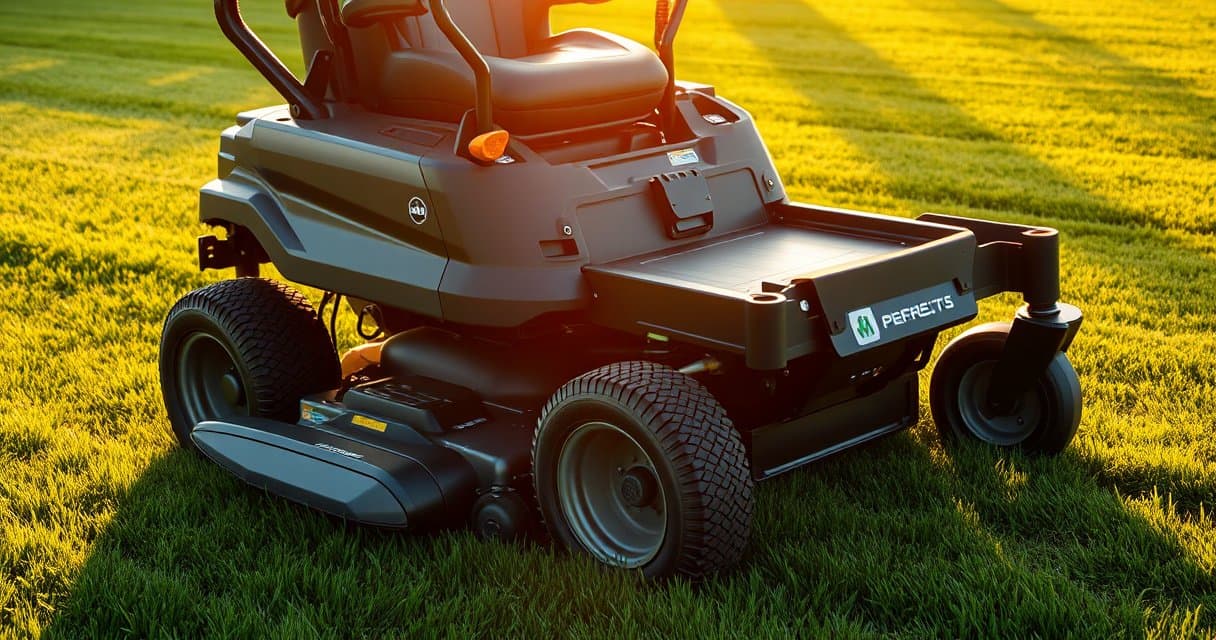
Choosing a self-propelled lawn tractor
Choose the perfect ride-on tractor for your garden. Key tips for size, slope, and model selection to turn mowing from a chore into a pleasure.
Articles you might like
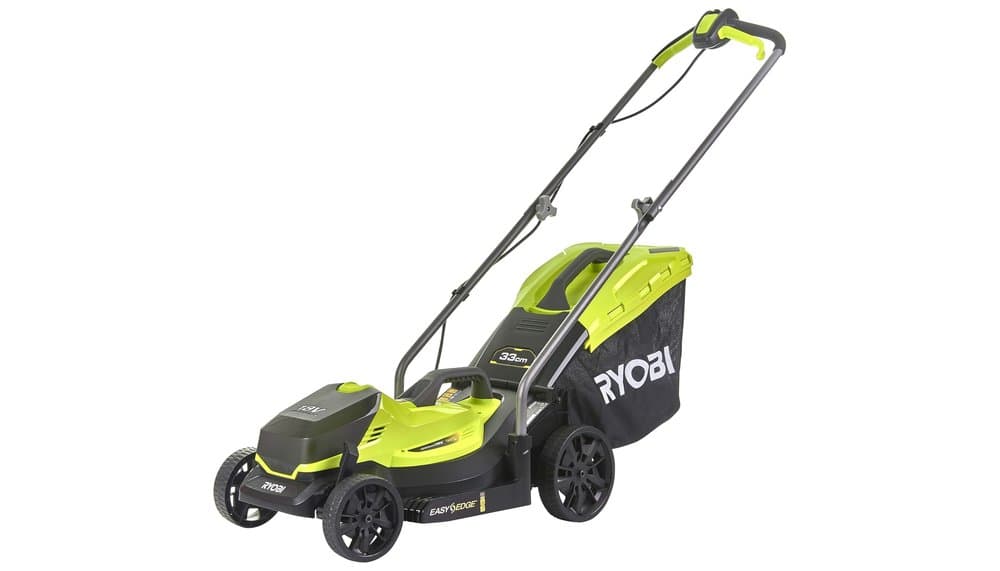
Ryobi One+ RLM18X33B40 18V Cordless Mower Review
RYOBI 18V cordless mower for small gardens, part of the ONE+ ecosystem using a universal battery compatible with over 200 tools.
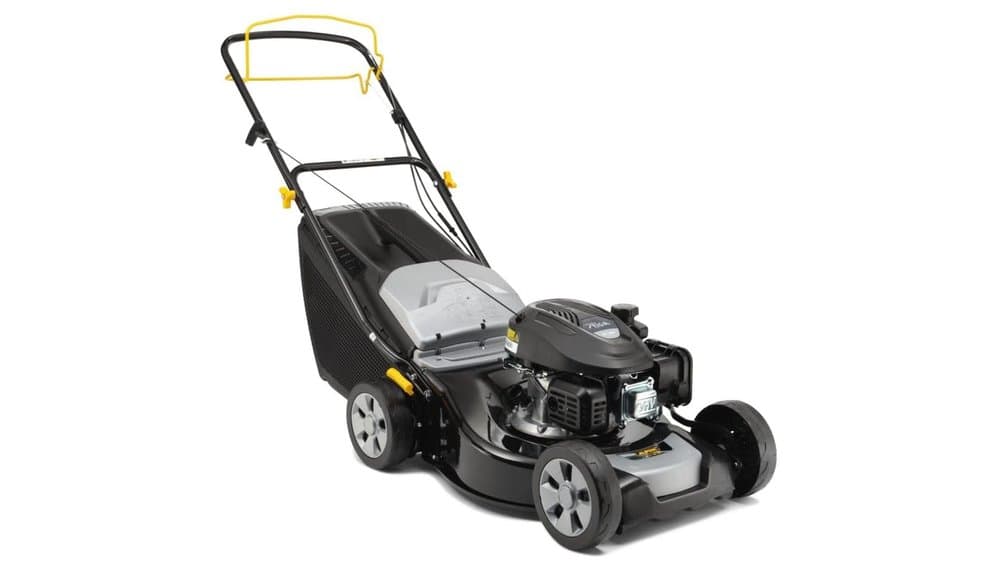
Alpina AL4 46 SA Petrol Lawnmower Review & Test
Alpina AL4 46 SA review: A robust, self-propelled petrol mower for medium to large gardens. We analyze its specs, performance, and user feedback.
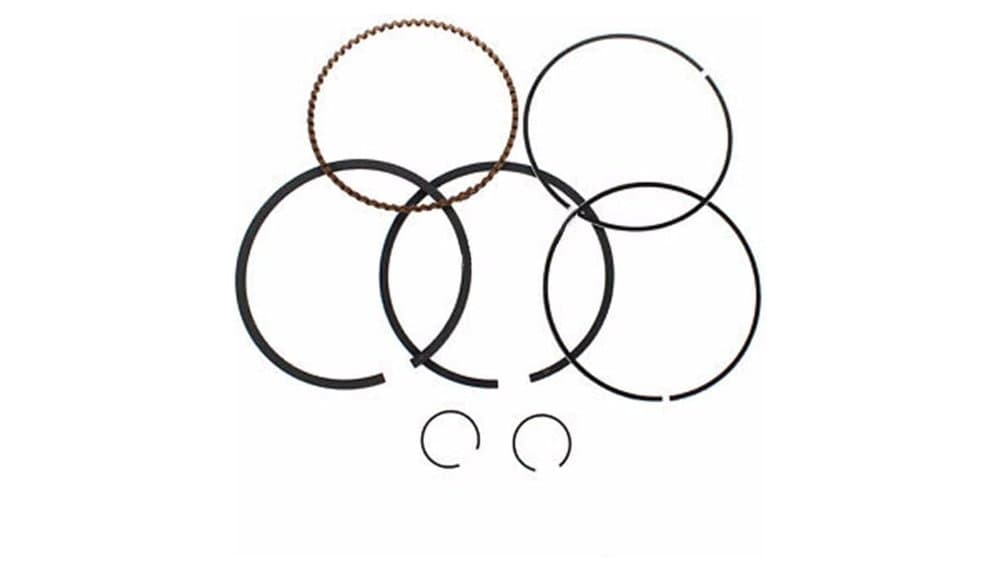
LIZONGFQ GX390 Engine Rebuild Kit Review
Restore performance: Rebuild your Honda GX390-type lawn mower engine instead of replacing the entire machine with cost-effective repair parts.