WORX Landroid Vision WR206E.1 Robot Mower Review
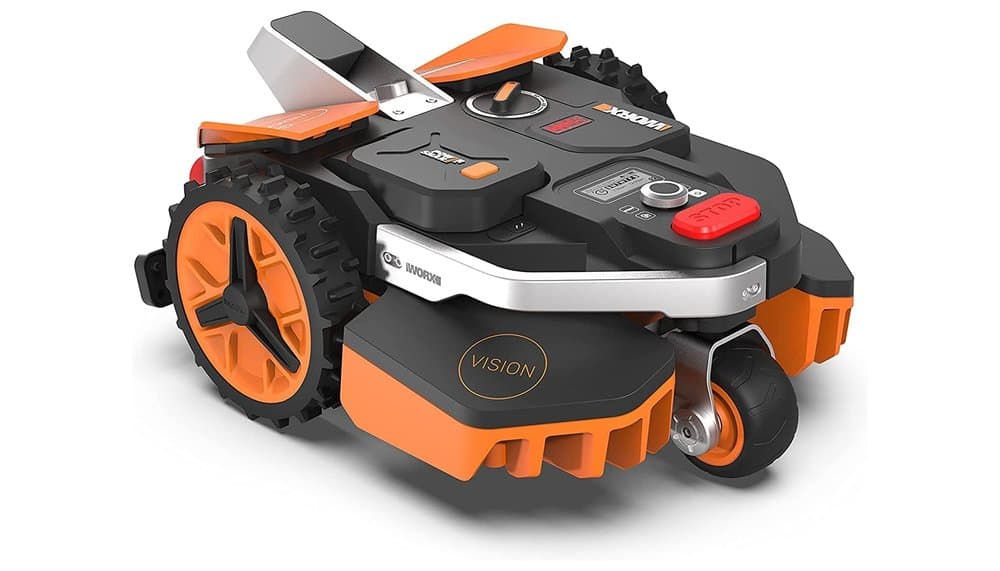
Analysis of the WORX Landroid Vision WR206E.1: Is the "Vision" Robot Mower the Future?
Among robot mowers, the wireless, visually navigating model represents the holy grail: extremely simplified installation and intelligence supposedly close to that of a human. The WORX Landroid Vision WR206E.1 embodies this promise. With its 4K camera and adaptive artificial intelligence, it aims to completely eliminate the tedious perimeter wire. But does this cutting-edge technology deliver on its promises in the field? Through a detailed analysis of its specifications, community feedback, and expert observations, we separate fact from fiction about this robot that aims to revolutionize lawn care.
Strengths
The technical strengths of the WR206E.1 are clearly oriented towards ease of use and intelligence.
- Ultra-fast, wireless installation: This is its main selling point. According to specifications, installation takes about 30 minutes. This avoids the hours spent burying or laying a wire. You simply place the charging station and let the robot discover its environment.
- Promising vision and AI navigation: Equipped with a 4K camera and adaptive AI, the robot is designed to distinguish grass from obstacles. On paper, it can autonomously avoid objects, animals, or flower beds, even adapting to slopes up to 30%.
- "Cut-to-Edge" Function and Clean Finish: It inherits WORX technology enabling edge-to-edge mowing. This significantly reduces the need for finishing work with shears or a manual mower along borders and walls.
- Integrated WORX PowerShare Ecosystem: The robot uses a 20V/4Ah battery compatible with the entire WORX line of wireless tools. This is a practical advantage for users already invested in the system, allowing them to share batteries between tools.
- Wireless Multi-Zone Management: Thanks to RFID tags placed on the ground, the robot can manage multiple separate lawns (e.g., front/back yard), a feature typically complex to implement wirelessly.
Weaknesses
Field reports from both users and testers highlight the current limitations of this visual technology.
- Uneven Reliability of Visual Navigation: This is the main point of friction. Many users report that the AI is not infallible. The robot can get stuck on thin obstacles, push small objects, or even try to climb low borders. A recurring criticism is that the camera sometimes seems ignored, with the robot behaving like a basic bump-and-go model.
- Software and App Room for Improvement: Reports mention bugs in the mobile app: very slow status updates, remote commands not executed immediately (like the return-to-base order), and an occasionally unresponsive interface. Initial calibration and mapping can be sensitive to lighting conditions.
- Lighting-Related Constraints: To function at night – an often-desired feature for discretion – purchasing an optional LED kit at a significant extra cost is necessary. Without it, the robot reports an "insufficient lighting" error as soon as light levels drop, limiting its operational window in autumn or on overcast days.
- Very Specific Ideal Terrain: Contrary to what wireless marketing might suggest, this robot does not like complex gardens. Based on shared experiences, it is better suited to a single, open area, free of steps, narrow passages, or paths to cross. Setting up reliable multi-zone management via RFID is described as difficult.
Detailed Feature Analysis
The Cutting System and Finish
The WORX Landroid Vision uses a standard mulching system for robot mowers. Three rotating blades cut the grass into fine particles that are returned to the lawn as natural fertilizer. The cutting width is 18 cm, which is standard for a robot intended for medium surfaces (up to 600 m² recommended, 700 m² max). The cutting height, manually adjustable from 30 to 60 mm, covers most needs. The real plus is the Cut-to-Edge technology, which, when working well, offers an impeccable finish along edges. The chassis material is primarily robust plastic, helping to keep the weight down to 13.5 kg.
Navigation: The Revolution (and Its Limits)
This is the heart of the product. The WR206E.1 uses hybrid navigation via 4K camera + AI and RTK GPS (not mentioned in the product sheet but confirmed by web expertise). This combination theoretically allows it to map the garden and locate itself without a perimeter wire.
- Theoretical Advantage: No wire to install. The AI should allow it to proactively avoid obstacles (furniture, pets, toys) rather than just by contact.
- Practical Reality: Testers and users are mixed. While some report successful navigation around trees and large objects, others describe erratic behavior around flower pots, borders, or slopes. The initial mapping can fail on complex terrain. Web expertise notes that this visual navigation is less reliable and predictable than a proven wire-based system, especially in low light.
Garden Management and Autonomy
The promise of wireless multi-zone via RFID is ambitious. In practice, reports indicate its implementation is delicate and a source of problems (robot can't find the passage, gets stuck). The advertised slope capability of 30% (or 84% according to expert sources) is excellent on paper, but traversing it greatly depends on traction and terrain nature (wet grass, loose soil). The WORX app allows for scheduling, monitoring, and remote control, but its ergonomics and stability are regularly criticized by the community.
Robustness and Maintenance
With an IPX5 rating, the robot is protected against water jets. It can therefore operate in light rain, an advantage for maintaining a regular mowing schedule. Its 59 dB noise level is indeed very discreet. Maintenance is standard: regular chassis cleaning (especially after mowing wet grass) and blade replacement every 1 to 2 months for a clean cut. The 3-year warranty (conditional upon registration) is a positive point, providing peace of mind for a high-tech product.
Technical Specifications
| Characteristic | Detail WORX Landroid Vision WR206E.1 |
|---|---|
| Recommended Area | 600 m² (Max 700 m²) |
| Cutting Width | 18 cm |
| Cutting Height | 30 - 60 mm (manual adjustment) |
| Cutting Type | Mulching |
| Navigation | 4K Camera + AI + RTK GPS (wireless) |
| Max Slope Announced | 30% (per spec sheet, 84% per tests) |
| Multi-Zone Management | Yes, via RFID tags |
| Battery | 20V / 4Ah Li-ion (PowerShare) |
| Autonomy | Variable by terrain, covers the area |
| Charge Time | Approx. 60-90 min (1.5A charger) |
| Connectivity | App, Wi-Fi, Bluetooth |
| Noise Level | 59 dB |
| Protection (IP) | IPX5 (resistant to water jets) |
| Weight | 13.5 kg |
| Edge Function | Yes (Cut-to-Edge) |
| Rain Detection | Yes (can be programmed) |
| Warranty | 3 years (2+1 after registration) |
What Users and Testers Say
The average rating of 3.8/5 stars on major platforms summarizes the ambivalence of the feedback well. There is a clear divide between satisfied and disappointed users.
Recurring Positive Points:
- Simple and quick installation for those who succeeded with the mapping. "Received today and already running after a quick half-hour," reports one user.
- Effective and quiet mowing on suitable terrain. "The result is clean," "our lawn is always immaculate."
- Great comfort once dialed in: "The chore of mowing has become a real pleasure."
Negative Points and Frustrations:
- Faulty AI: This is complaint number one. "It tries to push walls (what's the camera for?!). It tries to push stones bigger than itself," writes one highly critical user.
- Software Issues: Slow app, commands not obeyed, unstable updates. "When you tell it to go home, it keeps mowing."
- Difficulties on Complex Terrain: Multi-zone management and narrow passages are problematic. "It's only usable on a single, open lawn... with no little corners."
- Cost of Options: The necessity to buy an expensive LED kit for night mowing is poorly received.
Expert reviews confirm these trends. They praise the innovative approach and lack of wire but emphasize that the reliability of visual navigation does not yet match that of a traditional wire-based system, particularly in gardens with many obstacles or level changes. They advise meticulous terrain preparation (complete clearance) to maximize chances of success.
Conclusion: Who Is It For?
The WORX Landroid Vision WR206E.1 is not a robot mower like the others. It represents an ambitious technological bet. Its main asset – the lack of a wire – is also the source of its primary weakness – an artificial intelligence that still needs refining.
We recommend this robot primarily to tech-savvy DIY enthusiasts with patience and a relatively simple garden. Ideally, a single, open lawn with clear, spaced-out obstacles, and no need to manage complex multiple zones. For these users, the simplicity of installation and the absence of a wire outweigh the occasional navigation hiccups.
Conversely, we advise against it for people seeking absolute "set it and forget it" reliability, or those with a complex garden (multi-level, paths, many flower beds, thin objects on the ground). In these configurations, feedback shows that frustrations (frequent interventions, software bugs) are likely to outweigh the benefits. For these cases, a wire-based robot, although longer to install, will offer a generally more predictable and worry-free experience.
The Landroid Vision is therefore a pivotal product. It shows the way forward for robot mowers but reminds us that, in practice, vision technology still needs to mature to compete with the brute-force robustness of a simple buried wire.
100% free and independent — All our articles are written independently, without any sponsorship. We may earn a commission on purchases made through our links, at no extra cost to you.
Articles you might like
Ryobi One+ RLM18X33B40 18V Cordless Mower Review
RYOBI 18V cordless mower for small gardens, part of the ONE+ ecosystem using a universal battery compatible with over 200 tools.
Alpina AL4 46 SA Petrol Lawnmower Review & Test
Alpina AL4 46 SA review: A robust, self-propelled petrol mower for medium to large gardens. We analyze its specs, performance, and user feedback.
LIZONGFQ GX390 Engine Rebuild Kit Review
Restore performance: Rebuild your Honda GX390-type lawn mower engine instead of replacing the entire machine with cost-effective repair parts.
Guides you might like

Ultimate Guide to Gas Mowers
Petrol lawnmowers provide power & autonomy for large lawns over 500 m². Key features & selection criteria for your garden explained.
Buying Guide: Choosing Your Thermal Brushcutter
Guide to choosing a thermal brushcutter: Compare 2-stroke vs. 4-stroke engines and harness types for effective clearing of brambles and sloped terrain.

Wireless robotic lawn mower guide
Choose the perfect cordless robotic lawn mower. Learn to match battery life, cutting width, and your garden's layout for a flawless, hands-free lawn.